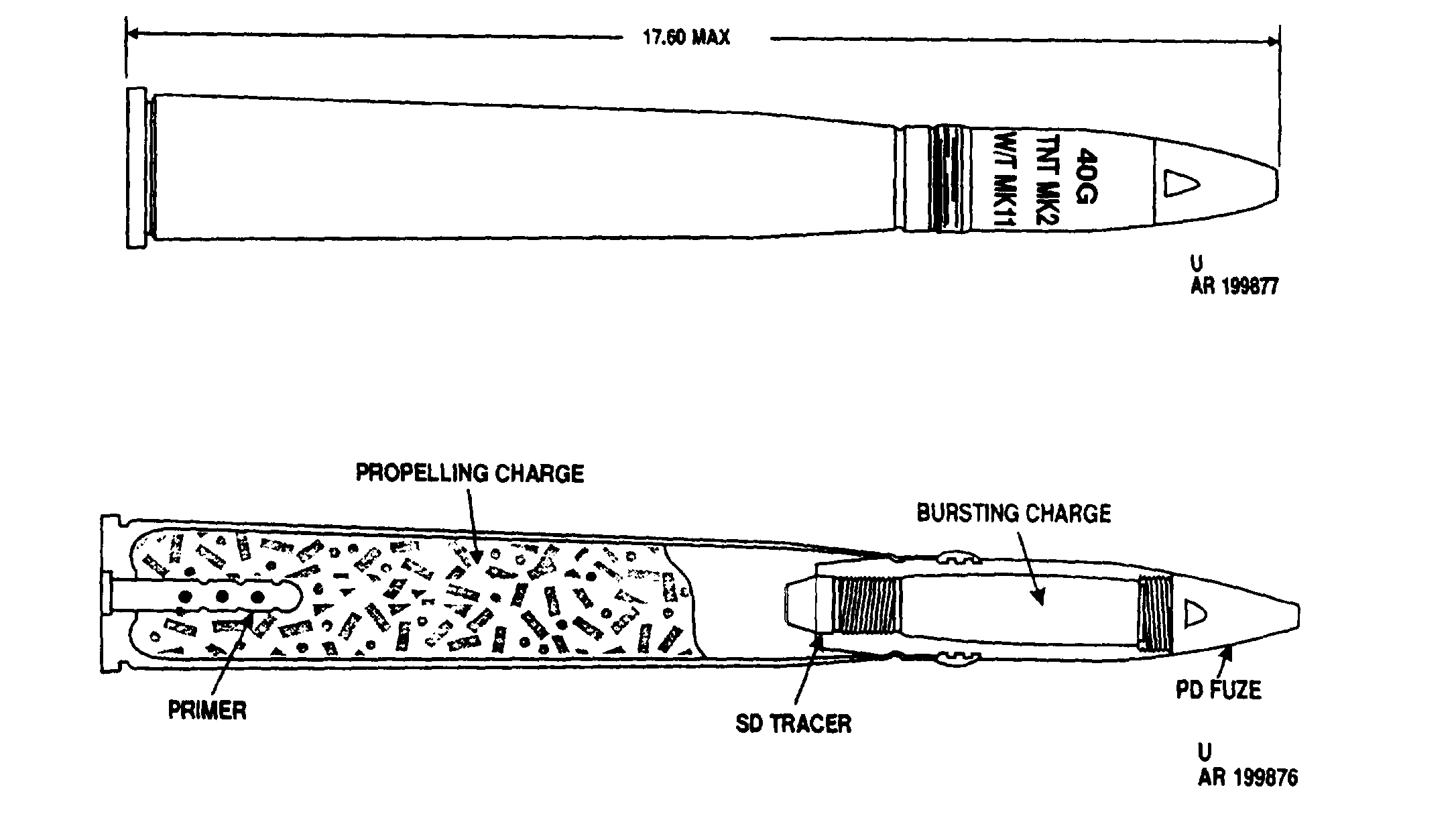
Description
This cartridge is used in 40mm gun cannons for firing against materiel.
The thin-walled projectile contains a TNT bursting charge, a point-detonating fuze, and a self-destroying tracer. The projectile nose is internally threaded to receive the fuze. The boat-tailed base has a self-destroying tracer assembly threaded internally. The assembly protruding approximately 0.6 inch from the base, contains an igniting charge, a tracer composition, and a relay igniting charge of black powder. The projectile is assembled with either a brass or steel cartridge case containing a percussion primer that is crimped to the projectile by means of a 360° crimp.
The MV2700 is similar except the tracer is M3 or M3A1 and the projectile is loaded with tetryl.
Army projectiles are olive drab with yellow markings. Navy projectiles are green with white markings and a green tip fuze.
Functioning
When the percussion primer is struck by the firing pin of the weapon, the black powder in the primer tube is ignited. Sparks from the black powder ignite the propellant, which, in turn, imparts velocity to the projectile and ignites the tracer. The high-explosive bursting charge is detonated by either the fuze functioning or the tracer relay igniting charge, depending upon whether contact with a target or the burning out of the tracer occurs first. The tracer composition burns with a visible trace for 8 to 10 seconds.
Hazardous Components
Cartridge case - M25, M25B1 for American design. M22A1 or M22A1B1 for British rounds
Propelling charge - M1 propellant (0.72 lb, 0.33 kg) or FNH smokeless powder (10.4 oz, 0.3 kg)
Primer - M23A2, M38, M38B2 or Mk 2. No. 12 Mk II/L may be found in British rounds
Tracer - Mk 11, Mk 11 Mod 2; M3, M3A1-Red.
Filler - TNT or Tetryl (0.14 lb, 0.06 kg)
Physical Data
Length, overall - 17.6 in, 447 mm
See Also
Primer, Percussion, No. 12 Mk 2 /L/
Source(s)
TM 43-0001-28, Artillery Ammunition (chg 11, 2003)
TM 9-1300-203, Artillery Ammunition (1967)
TM 9-1904, Ammunition Inspection Guide (1944)
