|
Japanese Bomb, 30 kg Air to Air, Type 99 No. 3 Mk 3, Type 99 No. 3 Mk 3 Modification 1 |
Scroll Prev Top Next More |
Description
Gray body and tail. A 2 inch silver band around the nose, a 1 inch silver band on the end of the tail fins, and two red lines diametrically opposite run from nose to tail. New markings will be found.
A cast steel nose piece is circumferentially welded to a longitudinally welded steel body. A canister containing the incendiary pellets is fitted inside the body . A steel tube containing the central burster charge is screwed into the nose and extends the length of the body . A tail cone is circumferentially welded to a collar which threads into the after end of the body. The tail cone is filled with picric acid. A steel plate separates the explosive from the incendiary filler.
Four steel fins are spot welded to the tail cone. They are braced by a single set of ifs-inch round struts flattened at each end and riveted to the fins. To impart the rotary motion necessary to arm the D-2 fuzes, the ends of the tail fins are bent to an angle of approximately 19°.
A factory variation of the incendiary filling consists of 21 lengths of mild steel pipe, 1 inch in diameter, packed vertically in the canister. Each length is divided into 8 equal sections by being cut completely through except for 1/4 inch of circumference left along 1 side. The bomb contained 168 phosphorus filled pellets.
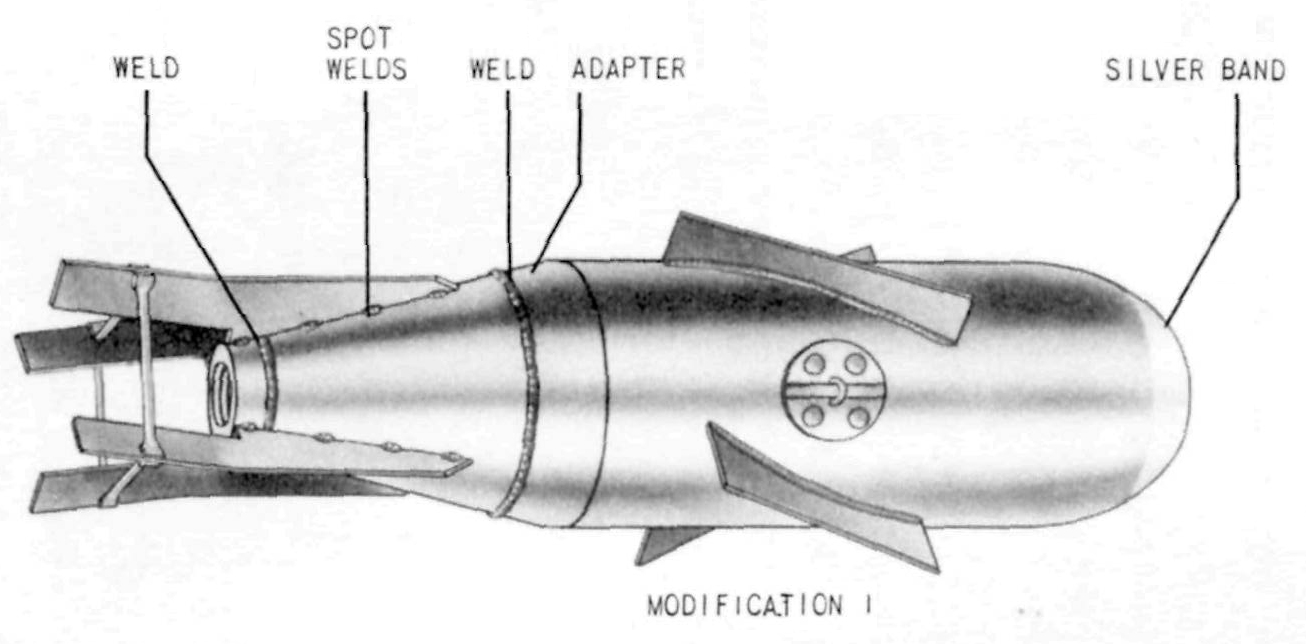
Modification 1: A variation of this bomb listed as Modification 1 has four fins welded to the body and utilizes the new color markings . The fins, which are 6 inches long, 1 1/2 inches wide and 1/16 inch thick, are welded to the body at 4 5/8-inch intervals, two between each suspension lug. They are offset 35° from the longitudinal axis of the bomb and serve to accelerate its clockwise rotation. The bomb is painted gray. It has a silver nose tipped with green. The tail struts are red.
Hazardous Components
Canister containing 168 phosphorus filled steel pellets. Picric acid (3.5 lbs, 1.6 kg) in tail cone and central burster charge.
See Also
General Information, Japanese Navy Bombs
Nose, A-1(b)
Nose, A-3(c), Type 2 Initiator
Tail, D-2(c), Aerial Burst
Source(s)
