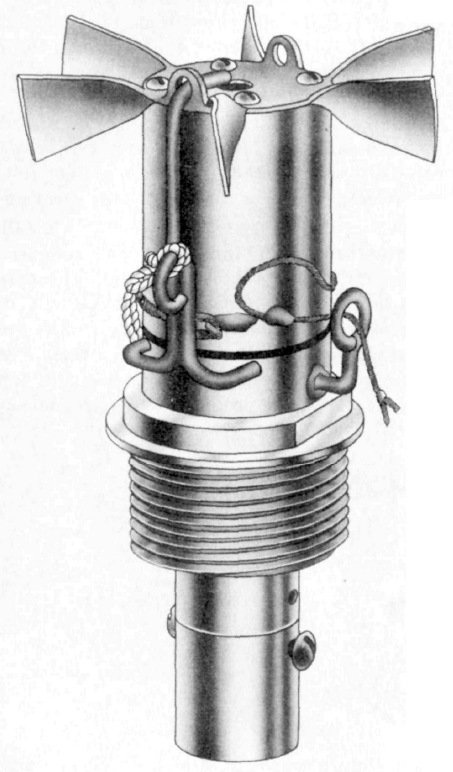
Description
Also known as Type 2 Nose Priming Mechanism, Model 2.
Steel with brass striker spindle and nose cap.
No locking or anti-withdrawal device.
The fuze consists of four main parts: the fuze body, the striker spindle, the nose cap, and the detonator holder. The fuze body contains the striker spindle which is held in place by a shear wire and a locating screw. The lower end of the body is grooved to receive the screws in the detonator holder. A safety fork fits into the upper side of the fuze body, one prong of the fork extending up through eyelets in the vane assembly to prevent premature vane rotation.
The brass striker spindle is of one piece construction except for the steel firing pin which screws into the lower end. A threaded flange, 1 inch in diameter, at the top of the spindle screws into the nose cap. The spindle is drilled to take the shear wire; a keyway in the side of the spindle receives the locating screw which prevents rotation or upward movement.
The brass nose cap, unlike that of the A-3(a), is of one-piece construction. The cap is internally threaded to receive the flange of the striker spindle. A six-bladed vane assembly is secured to the cap by four screws. The usual type starting wire is soldered to the side of the cap so that a rotary motion will be imparted to the vane assembly when the bomb is dropped. The detonator holder, similar to that of the A-1(b), is affixed to the lower end of the fuze body by two screws.
The threads on the striker spindle flange are 26 threads per inch.
The appearance of this fuze (armed) in a UXB will differ materially from that of the A-3(a). The visible parts will be the threaded brass striker spindle flange possibly resting flush against the top of the fuze body; the nose cap and vanes fall away after 37 revolutions.
Functioning
On release from the plane, the starting wire is pulled out through the eyelet, breaking it loose from the soldered contacts with the nose cap. Simultaneously, an initial rotation is imparted to the nose cap which rotates up on the striker spindle flange. The fuze is armed in approximately 28 revolutions and the vane and cap fall away after 37 revolutions. On impact; the striker spindle is forced inward, shearing the shear wire, and the firing pin pierces the primer.
Hazardous Components
Primer cap and detonator.
See Also
Nose, A-1(b)
Nose, A-3(a), Type 97 Mk 2 Model 2
Source(s)
OP 1667, Japanese Explosive Ordnance, Volume 1 (1946)
TM-E9-1984, Enemy Bombs and Fuzes, Section VII, Japanese Fuzes (1942)
