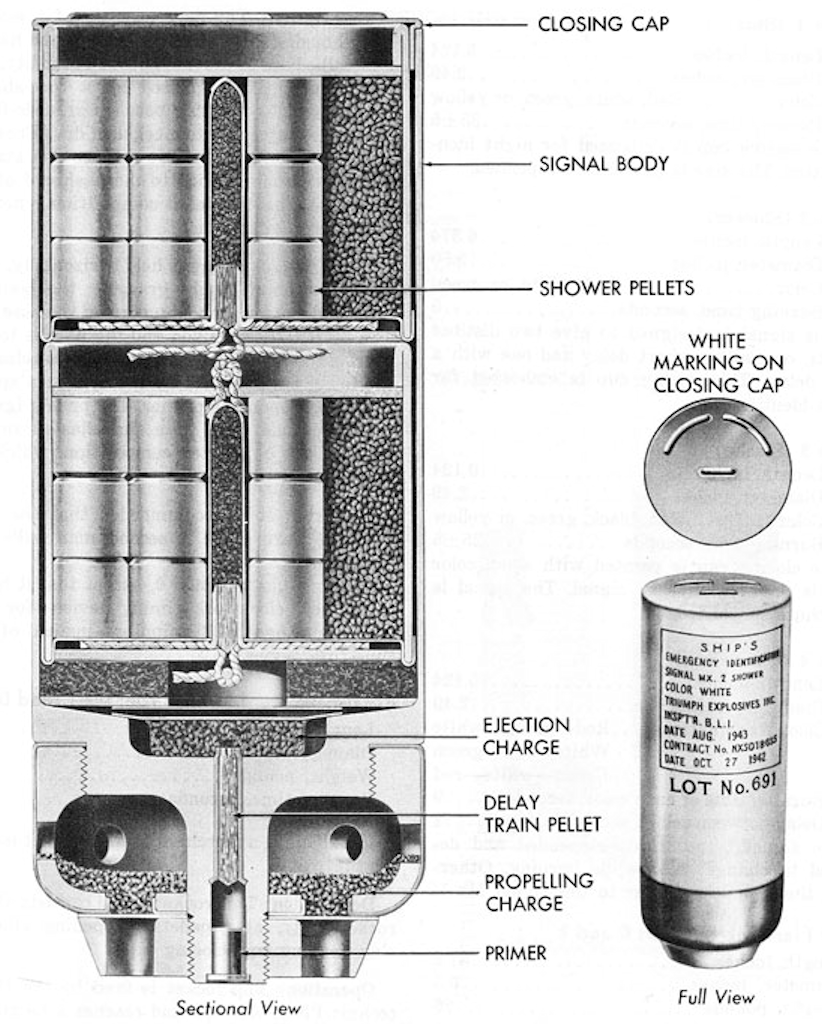
Description
The body of each of these signals varies in length according to its design. Each signal consists of a pressure-retaining disc and disc-locking nut, a primer, a four gram smokeless powder propelling charge, a copper obturating cup, a delay train, an ejection charge of approximately 1.1 grams of black powder, and a signal of pyrotechnic composition. All signal cups except the shower signals have a parachute for mid-air suspension.
Functioning
The signal is fired from Signal Projector Mk 1 or Mk 1 Mod 1. The signal is placed in the projector primer-first, where it rests against the retaining pin. A pull on the lanyard removes the firing pin and allows the signal to descend against the firing pin with sufficient force to close the valve and fire the primer. The primer ignites the delay train and propelling charge simultaneously. The gases from the propelling charge expand the obturating cup until it is secured tightly in the bore of the projector. Increased pressure ruptures the pressure-retaining disc, and the gases then escape through the openings in the retaining disc locking nut into the projector bore. The gases propel the signal approximately 600 feet. The ignited delay train bums until the signal reaches approximately the zenith of its trajectory, and then ignites the ejection charge. The ejection charge ejects and ignites the signal pyrotechnics through a quick match and first fire composition.
See Also
Nothing else to see.
Source(s)
OP 1664, Volume 1 - US Explosive Ordnance (1947)
USNBD - Bombs and Fuzes, Pyrotechnics (1945)
