Description
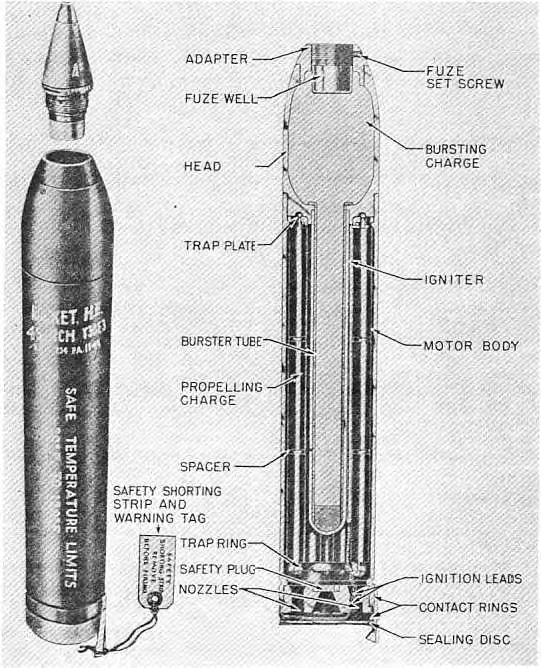
The head, loaded with high explosive, contains a fuze well cup and a burster tube. The burster tube projects about 15 inches into the center of the rocket motor to secure additional fragmentation. The motor body is a steel tube threaded at each end to receive the head and the nozzle plate, which contains eight nozzles equally spaced in a circle and one nozzle in the center. The eight nozzles are set at an angle in order to impart rotation to the round when fired. The center nozzle is normally closed by a blowout disc which is designed to fail when the internal pressure in the body surpasses a predetermined limit. The nozzle openings are protected by a plastic sealing disc which remains in place during firing and is blown out by the rocket blast.
The propelling charge consists of 30 grains of ballistite strung on wires of a cage-like trap. The igniter consists of a charge of black powder enclosed in a plastic tube attached to the trap and running the length of the charge. The tube also contains an electric squib. The leads of the squib pass through one of the nozzles, one lead being grounded to the motor body and the other connected to a contact ring.
The M16E1 has a deeper fuze cavity for the V.T. Fuze M402 (Mk 173). Shipped with these rockets is a supplementary charge to fill part of this cavity in case the Fuzes M81 or M48A2 are used.
The M16E2 is like the M16E1, except that purge pellets of 411E composition have been added to eliminate chunks in burning.
Functioning
No information about functioning.
Hazardous Components
No information about hazardous components.
See Also
Rocket, 4.5 inch HE, M20
Rocket, 4.5 inch Practice, M17, M17E1, M17E2
Source(s)
OP 1664, Volume 1 - US Explosive Ordnance (1947)
