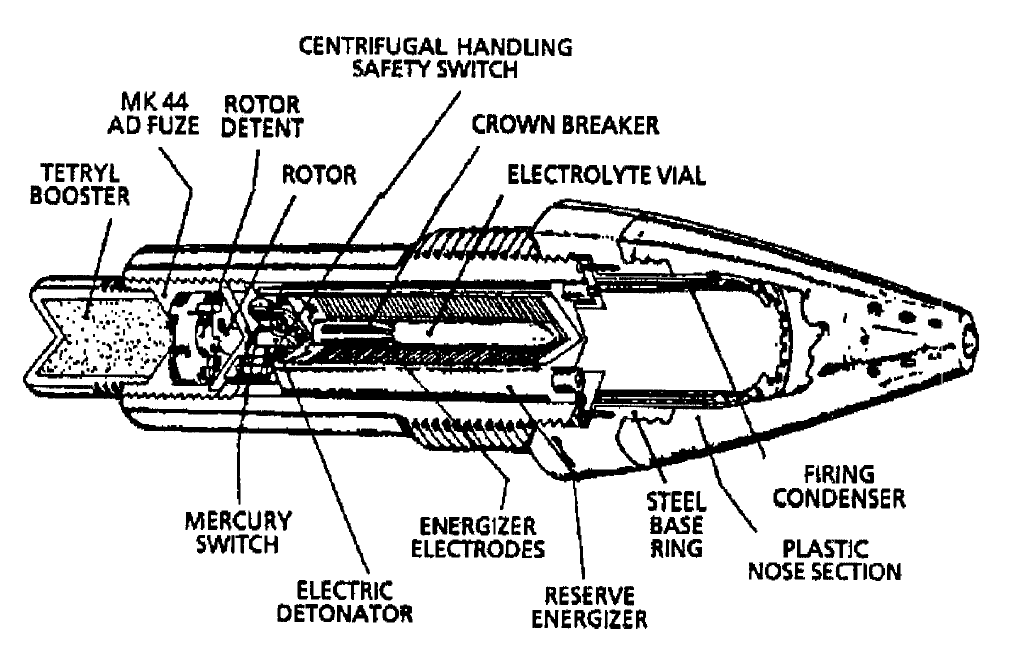
Description
The VT Fuzes Mk 58, Mk 47, and Mk 59 are equipped with two mercury switches instead of the single switch incorporated in the Mk 45 and Mk 58. This feature is provided to insure additional safety; in all other respects. these five fuzes are mechanically identical.
The differences in these fuzes lie in dimensions and contour of the head, thread sizes, and electrical characteristics (for slower spin, less setback etc.).
Functioning
When the round is fired, acceleration in the gun barrel causes the fingers of the crown breaker to open up, allowing the electrolyte vial to break against the bottom of the breaker. Centrifugal force distributes the electrolyte throughout the energizer, activating it in 0.2 to 0.8 second. Centrifugal force also opens the handling safety switch, which previously had been shorting out the firing condenser.
The firing condenser begins to accumulate a charge through its high-resistance electrical delay, and electrical energy is fed to the electric mechanism in the VT element. Centrifugal force causes the small globule of mercury in the mercury switch to move through a porous membrane into the lower chamber, thereby removing the electric short circuit across the primer leads. This requires from 0.2 to 0.9 seconds, depending on the fuze and the rate of rotation of the projectile. When the firing condenser has accumulated enough electrical energy to allow firing of the electric primer, 0.6 to 1.0 second, the fuze is fully armed.
Upon approach to a target under proper conditions, the reflected electromagnetic signal from the target causes the VT element to discharge the firing condenser through the electric primer. The blast from the primer functions the auxiliary detonating fuze, which, in turn, initiates the detonation of the projectile.
Hazardous Components
No information about hazardous components.
See Also
Nothing else to see.
Source(s)
MIL-HDBK-146, Fuze Catalog (1982)
OP 1664, Volume 1 - US Explosive Ordnance (1947)
OP 1664, Volume 1 - US Explosive Ordnance (1947)
