Description
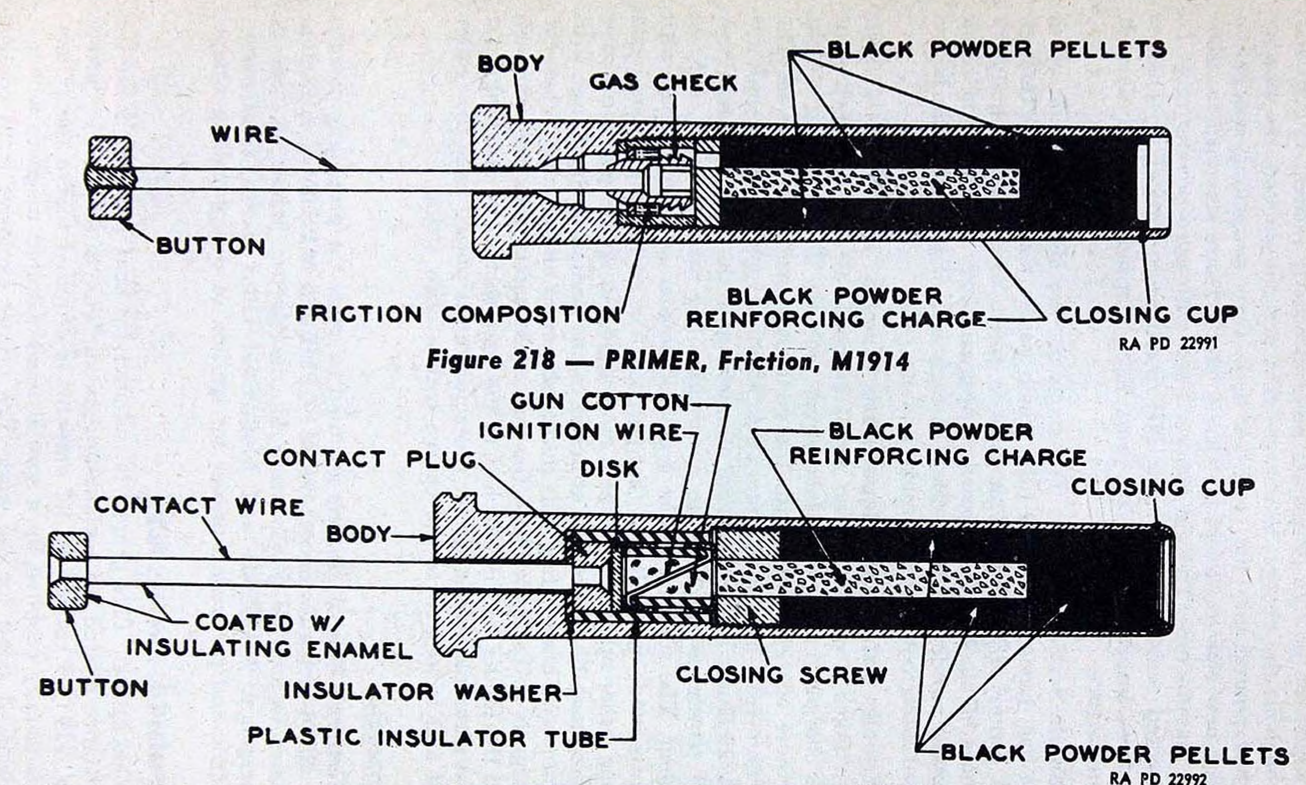
This primer is initiated by heat resulting from the resistance offered by a platinum ignition wire to an electric current. A current of 1.1 amperes is required to fire the primer. It is usually supplied by a special hand operated magneto which is considered safest for the work. The primer explosive train consists of guncotton wrapped around the platinum ignition wire; 3 grains of loose black powder over the guncotton and extending into a hollow black powder pellet weighing 13.39 grains; and a solid pellet of black powder weighing 22.80 grains. The primer is sealed at the forward end with shellac and a chipboard closing cup.
Functioning
One electrical contact is made with the button and the other is made with the body, which, in contact with the firing mechanism of the gun, forms the ground. The electrical current therefore, flows through the system as follows:
1. From the magneto to the button.
2. From the button through the contact wire to the contact plug, which is insulated from the body by a plastic insulator tube and an insulator washer of fiber. The contact wire is insulated with insulating enamel.
3. From the contact plug, through the brass disc, to the rear gilding metal cap which is in contact with the platinum ignition wire. The gilding metal cap is insulated from the body by the outer insulator tube, and from the forward gilding metal cap by the inner plastic insulator tube.
4. Through the ignition wire to the forward gilding metal cap which contacts the closing screw.
5. Through the closing screw to the primer body and breech mechanism. The remaining connection on the magneto is attached to the firing mechanism.
At the point of the ignition wire in the circuit, the resistance offered to the flow of electricity results in enough heat to ignite the guncotton which initiates the primer explosive train.
See Also
Nothing else to see.
Source(s)
TM 9-1904, Ammunition Inspection Guide (1944)
