Description
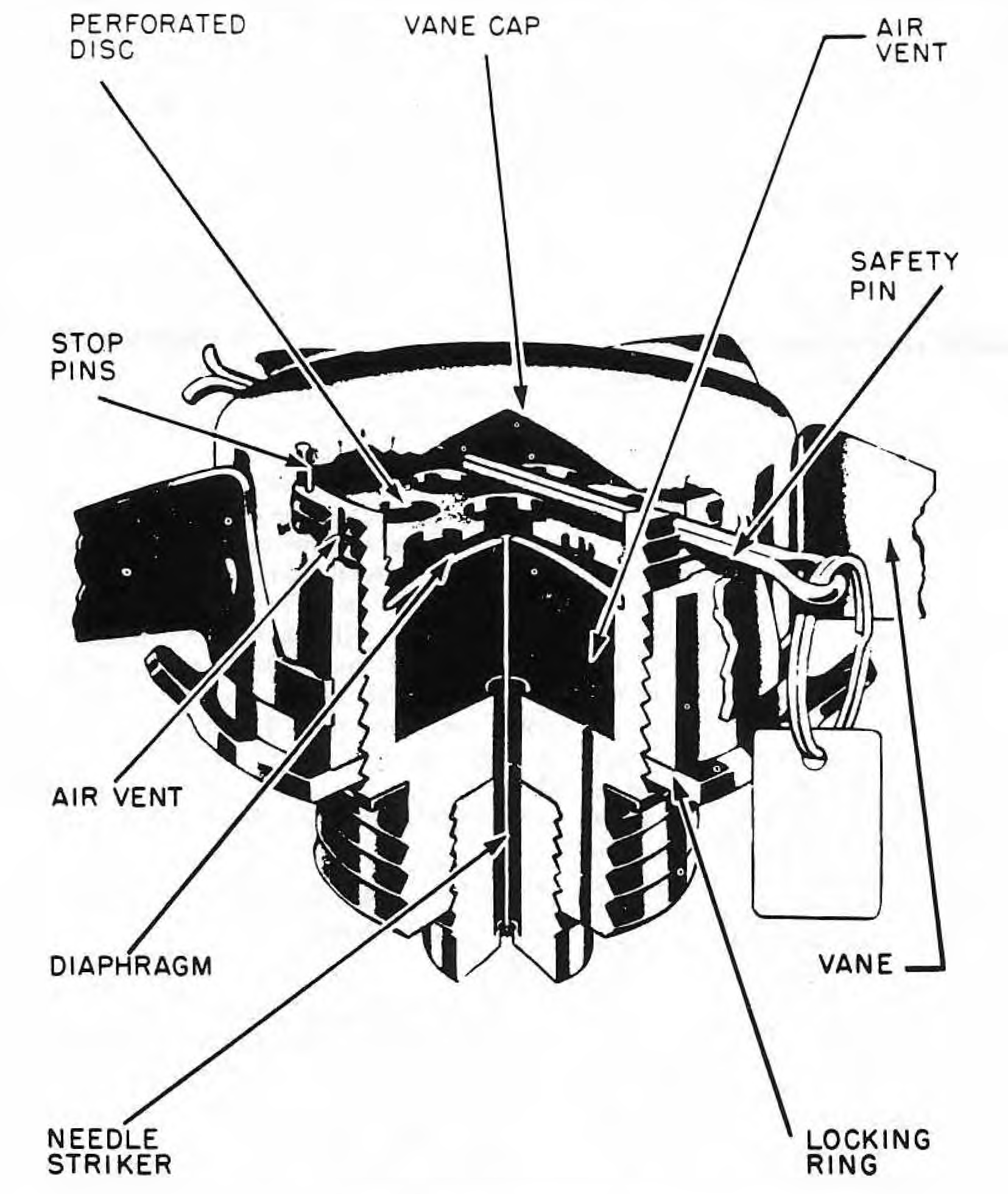
The Pistol No. 45 Mk I consists of a vane cap, body, and body extension, or striker guide. The pistol is similar to the Nose Pistols No. 44 and No. 55, but has a shorter shank so that it may fit smaller bombs. Six vanes in pairs are riveted to the black vane cap. A steel stop pin on the inside of the vane cap engages a similar pin on the top of the pistol body to prevent the cap from screwing down too tightly and binding. In the upper part of the pistol body there is screwed a steel retaining disc, in which are drilled seven holes to allow air passage. Located under the disc is a sheet brass diaphragm to which is soldered a steel needle striker, which extends into the body extension. There are two air pressure holes in the side of the body which equalize the pressure above and below the diaphragm as the bomb falls. Around the pistol body is a brass locking ring.
The Pistol No. 45 Mk II is similar to the Mk I, except that the two air vents in the side of the pistol body are replaced by three air vents in the base of the pistol body.
The Pistol No. 52 Mk I is similar to the No. 45 Mk II. except that only five vanes are used, and the vanes and vane cap are of unpainted brass.
The Pistol No. 52 Mk II is similar to the No. 52 Mk I. except that the vane cap is retained by a new-type spring safety clip, the hook end of which locates in a hole in one of the arming vanes, while the plain end passes through the single hole in the vane cap and engages a safety-pin groove in the pistol body. The two safety-pin holes in the cap and the four notches in the fuze body are omitted. The air pressure relief groove is diametrically opposite the safety-pin groove and extends from the top of the body to a point lei el with the top of the safety-pin groove.
Functioning
No information about functioning.
See Also
Nothing else to see.
Source(s)
OP 1665, British Explosive Ordnance (1946)
