Description
The impact nose fuzes of this type are vane operated and delay armed. They act to detonate the bomb instantaneously upon impact.
Although very similar in external appearance, the AN-M110A1 differs in numerous features from the AN-M158.
The AN-M110 and AN-M126 are identical in both construction and operation. The only difference is that the booster is eliminated from the AN-M126A1. Instead of the booster, a steel cylinder, having the same dimensions as the booster, is screwed into the base of the fuze body. This steel cylinder contains an enlarged firing train consisting of primer, upper detonator, and lower detonator, which is seated against the tetryl burster of the chemical bombs.
The original designs, M110 and M126, had more teeth on the gears, and consequently required 570 vane revolutions to arm. They also had three safety blocks, each 120° segments, and the arming sleeve fitted in a groove in the blocks in the unarmed position, preventing them from falling out. The original designs also had larger vanes.
If the striker head is flush with the fuze body, the fuze is in a fired condition. In such condition, the striker should not be pulled away from the fuze, as the firing pin is sensitive and withdrawal might create sufficient friction to ignite the primer.
Functioning
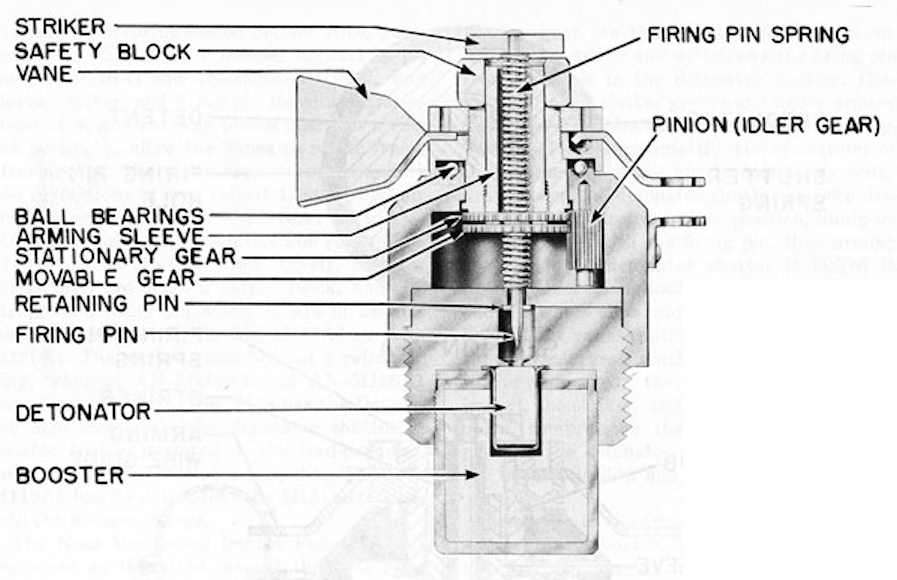
When the bomb is dropped and the arming wire pulled, the vanes rotate. The vanes are positively attached to the upper part of the stationary gear, which can rotate but cannot move in a vertical plane, because of a collar which rides in a groove in the fuze body. As the vanes and stationary gear rotate about the ball race, the movable gear, which is threaded up inside the stationary gear, also rotates. Both gears mesh with an idler gear, and (since the movable gear has one more tooth than the stationary gear) for each rotation the movable gear lags one tooth, thus unscrewing downward from the stationary gear. As the sleeve of the movable gear moves down, it releases the safety block, allowing the block to be expelled by centrifugal force. The sleeve is moved down far enough in 260 rotations of the vanes to arm the fuze. On impact, the striker is driven down, overcoming the resistance of the firing-pin spring; and the firing pin initiates the explosive action instantaneously.
Hazardous Components
Tetryl booster charge
See Also
Source(s)
MIL-HDBK-146, Fuze Catalog (1982)
TM 9-1385-51, Ammunition (Conventional) for Explosive Ordnance Disposal (1967)
OP 2216, Volume 1 - Aircraft Bombs, Fuzes, and Associated Components (1960)
TM 3-400, Chemical Bombs and Clusters (1957)
OP 1664, Volume 2 - US Explosive Ordnance (1947)
USNBD - Bombs and Fuzes, Pyrotechnics (1945)
TM 9-1904, Ammunition Inspection Guide (1944)
