Description
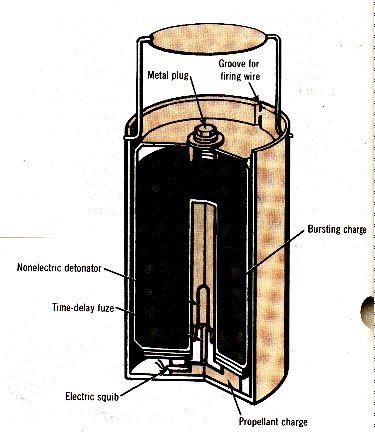
The two types of this chemical antipersonnel mine differ only in dimensions. The KhF-1 mine is 6 inches in diameter and about 14 inches high; the KhF-2 mine is 7 1/2 inches in diameter and 11 inches high. Externally, the mine closely resembles the bounding shrapnel mine. The KhF-1 bounding gas mine consists of a cylindrical sheet-steel container and a hollow, cylindrical sheet-metal mine unit which fits inside the container. The container is fitted with a carrying handle in the top and a vertical groove inside to hold the detonating cable. The mine unit is filled with 1.2 gallons (4.5 liters) of liquid contaminant and has a central well containing 10 grams of TNT (toluol) or picric acid (melinite) explosive. A threaded metal plug closes the contaminant filling hole on the top of the mine unit. A cork stopper with a 1/2 inch length of safety fuze is fitted into the well opening in the mine unit. The mine unit rests on two disks, one cardboard and the other metal. Both these disks rest on a 10-gram black powder propellant charge enclosed in a sheet-metal container. Each disk has a hole in the center through which the cork stopper projects so that one end of the safety fuse contacts the propellant charge. An electric detonator is inserted into the propellant charge and is attached to the electric detonating cable leading to a detonating station.
The KhF bounding gas mines are normally laid in groups of 10 to 12 mines, connected by electric cables to a detonating station at least 350 yards from the nearest mine. Individual mines are placed so that there is a minimum distance of about 18 yards between individual mines. Each mine is usually buried under 1 or 2 inches of dirt.
A variation of the KhF bounding mine consists of a metal mine unit containing the chemical charge in the upper compartments and an explosive charge in the lower portion of the unit, and has a central spring-loaded striker bolt built into the mine. The end of the striker bolt is connected to a metal pressure plate. The bottom of the fuze well is open to receive the percussion cap and the detonator. This unit fits into a metal container. The mine is buried in the ground with the pressure plate flush with the ground. It functions by being stepped on.
Functioning
Electrical ignition sets off the propellant, boosting the mine unit into the air. At the same time, the time fuse ignites and burns through and ignites the nonelectric detonator which detonates the explosive and bursts the gas cylinder at a height of 13 to 25 feet above ground. The gas will contaminate an area of 300 to 350 square yards with an average concentration of 20 to 25 grams per square yard.
Hazardous Components
Main charge - TNT, 10 grams
Propellant charge - Black powder, 10 grams
Contaminant - 1.2 gallons (4.5 liters)
Physical Data
Diameter - 7.5 in (191 mm)
Height - 11 in (279 mm)
See Also
Landmine, APERS, Bounding Shrapnel
Source(s)
TM 5-280, Foreign Mine Warfare Equipment (1963)
TM 5-223A, Soviet Mine Warfare Equipment (1951)
