Description
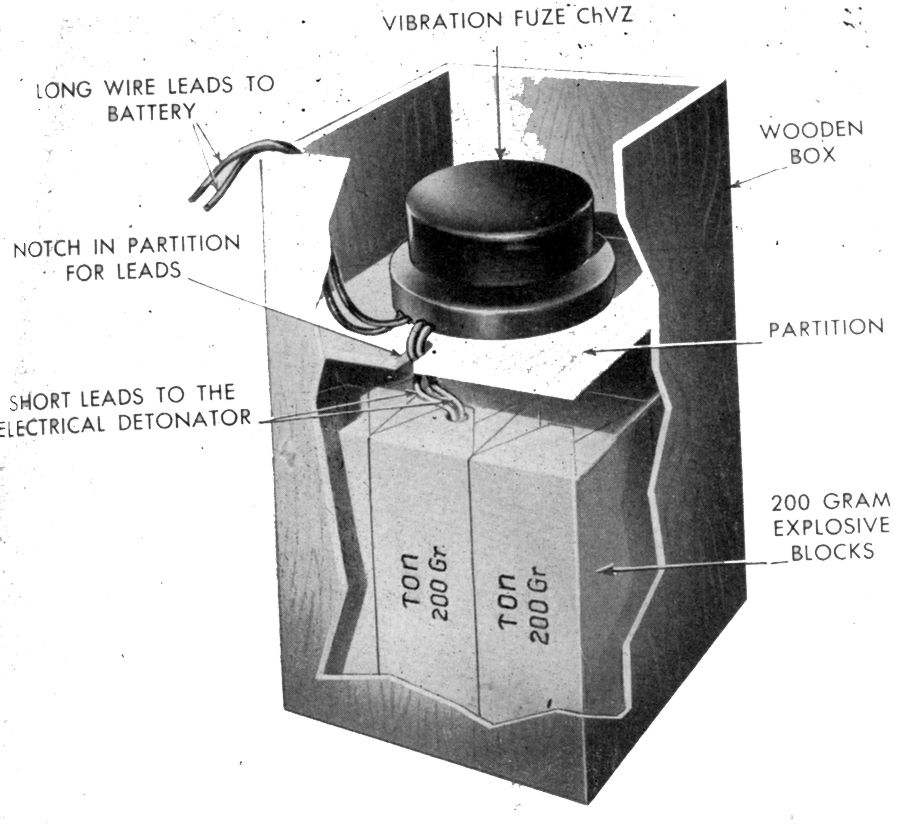
This mine consists of a rectangular wooden box, painted gray, and divided into two compartments by a horizontal partition. The lower compartment, holds about 2.7 pounds of explosive (six standard 200-gram blocks, or two 400-gram blocks and two 200-gram blocks). The upper compartment contains an electrical fuze with a ChVZ vibration delay fuze. A hole in the partition is for the short electric leads from the fuze to connect with the leads of an electric detonator in the charge compartment. Another hole in the top of the mine is for leading out the long arming wire leads from the fuze.
German reports describe two other models of this mine, the DM-3 and the DM-4, as being 6 1/8 inches square and 5 1/8 inches high. Both these mines use the VZ-1 vibration fuze. The DM-3 uses two fuzes, one set horizontally and the other vertically; the DM-4 uses only one. Both mines use a clockwork fuze for actual detonation of the mine, probably the ChMV-10 or 16 delay clock or the ChZ-10 delay clock.
This mine is designed for mining truck routes, and railroad and highway bridges. It is buried about 20 inches under railroad beds or 10 inches under roads and is often laid on a supplementary charge.
Functioning
Vibrations in the ground or structure where the mine is placed cause the spiral-spring contacts in the fuze to vibrate until one touches its metal housing, completing the circuit and exploding the detonator and mine.
Hazardous Components
Main charge - 2.7 lbs (1.2 kg)
Physical Data
Dimensions for DM-3 or DM-4
Length - 6.13 in. (156 mm)
Width - 6.13 in. (156 mm)
Height - 5.13 in. (130 mm)
See Also
Source(s)
TM 5-280, Foreign Mine Warfare Equipment (1963)
TM 5-223A, Soviet Mine Warfare Equipment (1951)
