Description
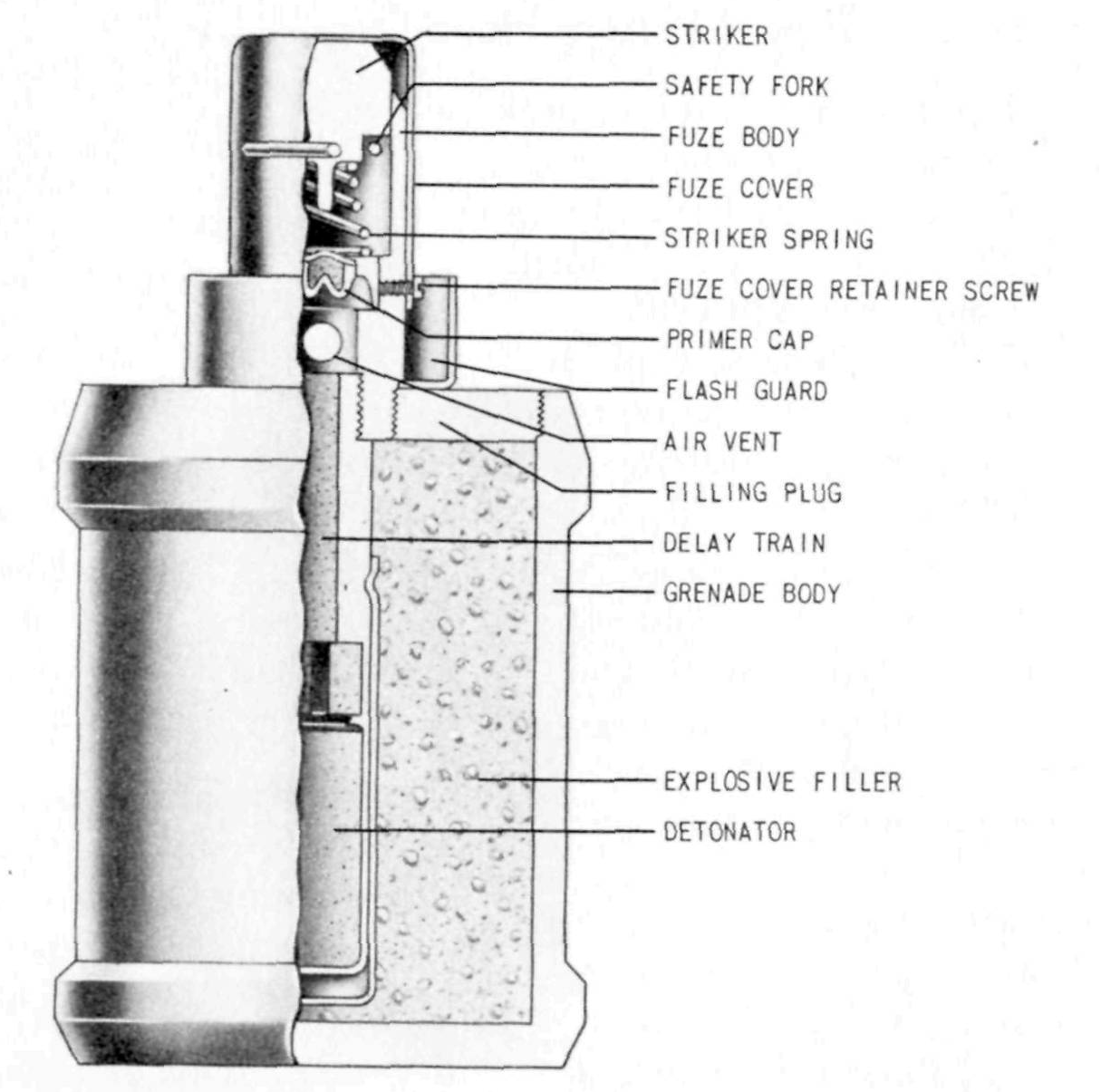
The cast steel body has smooth surfaces. There is a shoulder projecting 1/16 inch from each end of the body. The inside of the body is finished with lacquer to keep the filler from reacting with the steel case. The filler is also wrapped in heavy paper.
A light metal flash deflector is fitted in the top of the grenade. This deflector is 3/8 inch wide and 7/8 inch in diameter. Two 1/8 inch holes are punched in the outer periphery and match the spanner holes in the fuze body. This positions the gas vents in the fuze 90° from the holes in the flash deflector. The flash deflector reduces the possibility of the flash from the cap burning the hand of the thrower and the possibility of the flash being seen by the enemy at night.
The fuze is similar to that used in the Type 91 and 97 grenades with a few improvements. On the old type the striker may turn or spring clear of the grenade when the safety wire is pulled. In this fuze, a screw in the fuze body projects through a slot in the striker cover and keeps the cover in place. The slot allows the cover to move down when the striker is struck on a hard object. Also the striker and inertia weight are machined together and the striker protrudes so that it does not have to be threaded clown to arm the grenade. In other respects, the fuzes are identical.
A Type 99 grenade has been encountered with a machined, waterproof, metal fuze cover. The only difference between this variation and the standard grenade is the fact that the flash guard is externally threaded to receive the waterproof fuze cover.
Functioning
The safety pin is withdrawn and the head of the fuze is struck on some hard object. This forces the striker down into the primer igniting the delay.
Hazardous Components
Filler - Cast picric acid
Physical Data
Diameter - 1.63 in (41 mm)
Height - 3.5 in (89 mm)
Weight - 0.8 lb (0.4 kg)
See Also
Source(s)
