Description
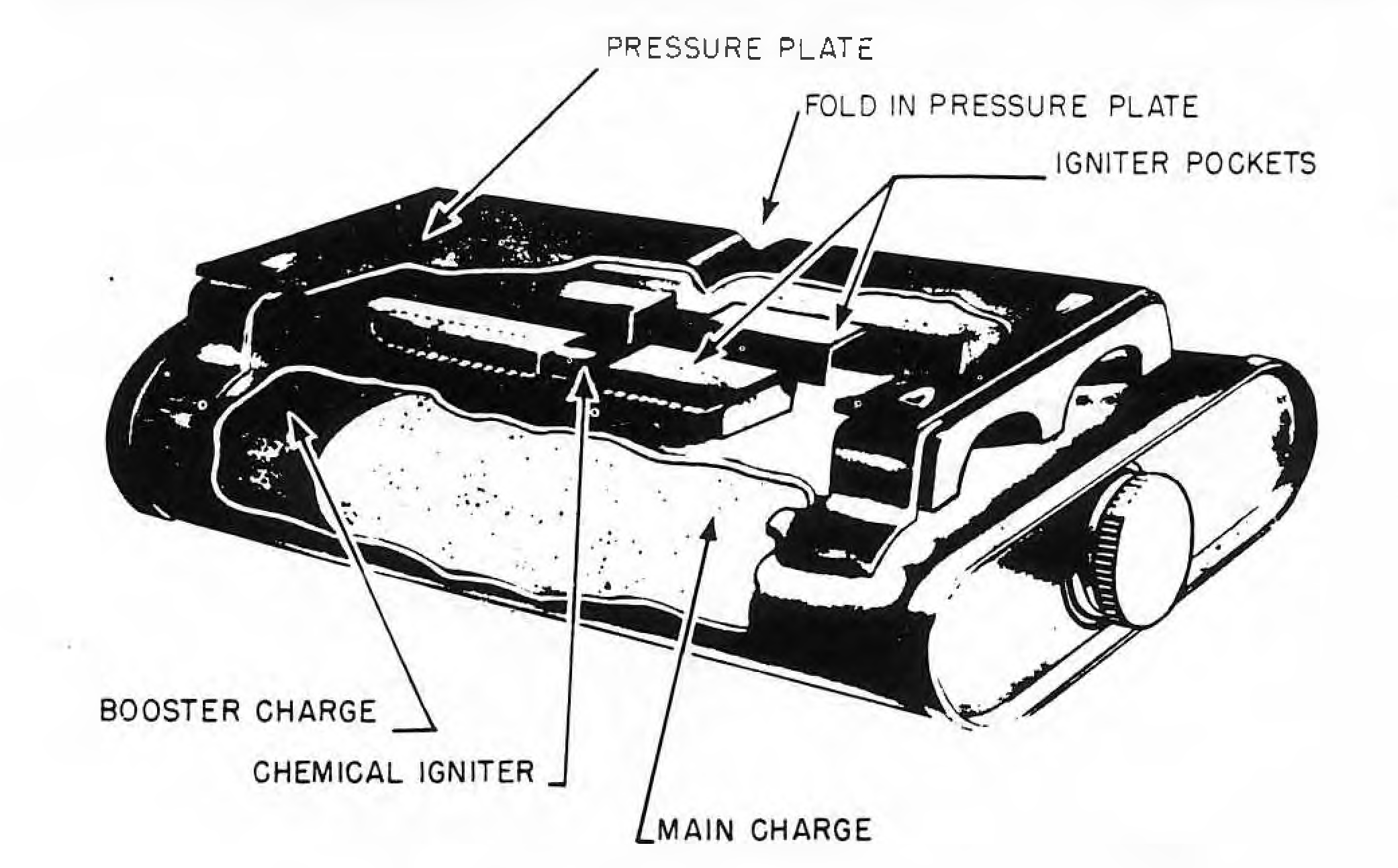
The Grenade Mk I consists of a 1 pint capacity, flat, tin plate can, which is rectangular in shape, and has rounded corners. It is filled through a hole in the end, over which a tin cap is screwed and cemented to provide watertightness. On one side of the can are two metal pockets with slots cut in them, which form the detonator holders. These pockets have malleable metal tabs which are bent to close them. The striker plate is supported above the detonator holders by two brackets, one on each end of the can. The striker plate is a light metal plate with a transverse projection on the bottom which serves as a striker. It is secured to the brackets by two bent tabs, so that the striker is immediately over the slots in the detonator holders. The principal differences beween the Grenades Mk I and Mk II lie in the fuze pockets, which in the Mk II are set at an angle for easier insertion of the fuze assemblies, and in the detonator assemblies. The Grenade Mk III is similar to the Mk II, but has no filling cap. It is filled with 1 3/4 lb. TNT, and two CE pellets.
When the Grenade No. 75 is filled with Ammonal, the designation is changed to No. 75 A. Ammonal is about 80% as powerful as the regular fillings.
The Grenade No. 75 is actually employed mainly as a land mine for defense against armored cars, tanks, and other vehicles. It will disable light tanks and vehicles and is used principally for hasty minefields.
The Grenade No. 75 is often referred to as the “Hawkins” grenade.
Functioning
No information about functioning.
See Also
Source(s)
OP 1665, British Explosive Ordnance (1946)
