Description
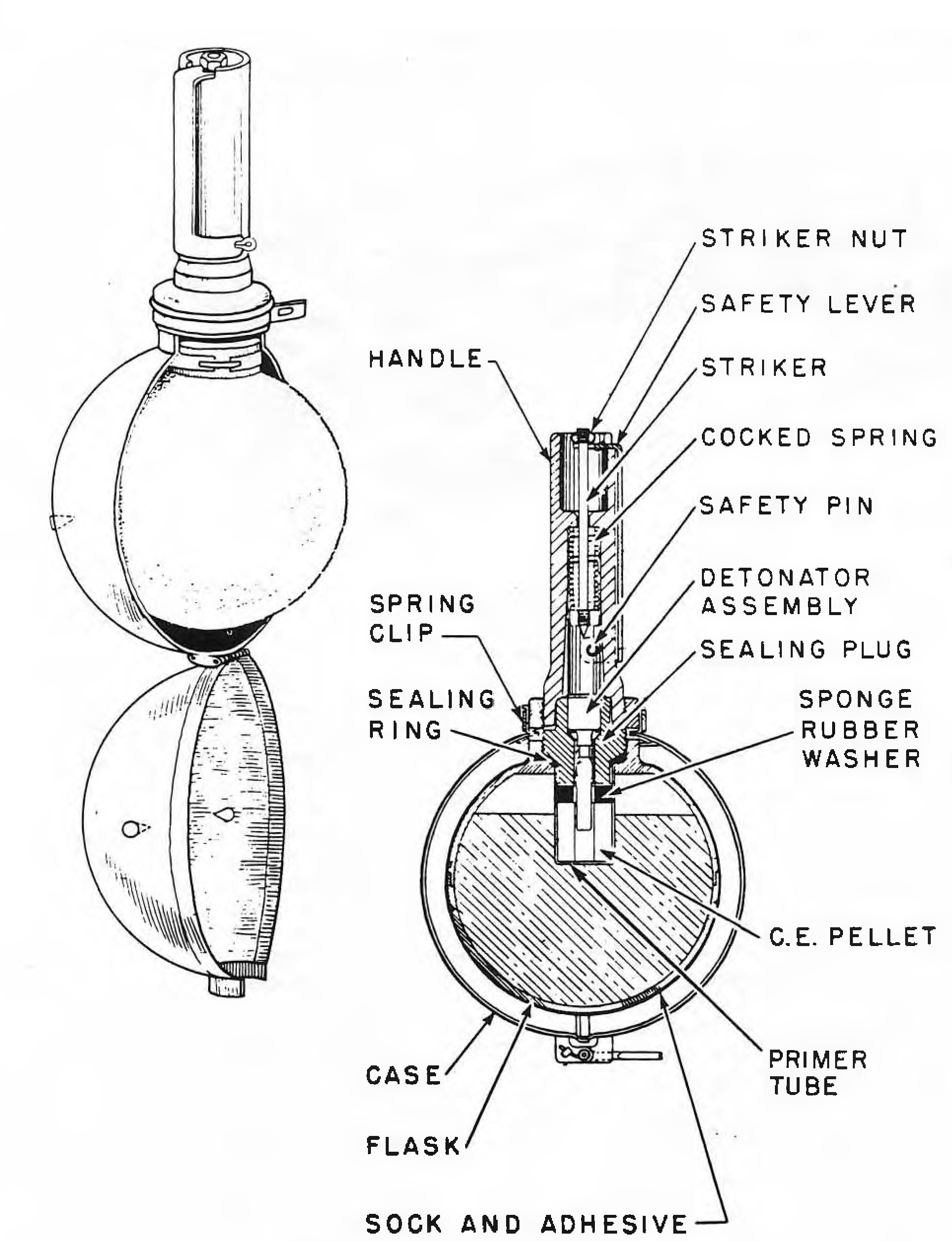
The Grenade No. 74 Mk II consists of a globular bakelite flask containing the explosive filling, which is primarily nitroglycerine and nitrocellulose, a bakelite handle containing the firing mechanism, and an adhesive treated sock. During filling, an air space is left to allow for expansion of the explosive. The sock covers the flask and is very sticky. The handle threads directly into the flask. Within the handle is a sharp striker and a striker spring. A safety lever fits under a nut on the head of the striker and down the handle to hold the striker up and the spring compressed. The top of the striker is spread to retain the nut. A safety pin passes through holes in projections on the safety lever, through the handle, and under the striker. The flask is closed at the neck by an externally threaded safety plug into which the detonator assembly is inserted immediately before use. The detonator assembly consists of a percussion cap, a 5 second delay, a detonator, and a CE pellet.
The Grenade No. 74 Mk I is similar to the Mk II in operation, but differs in several constructional details. The Mk I had a glass flask which proved to be too fragile and was replaced by bakelite in the Mk II. The Mk I was filled to capacity with explosive and consequently leaked if expansion took place. The handle was fastened to the body by a plastic retaining ring which gave too weak a joint. The blunt striker was a frequent cause of misfires. The Mk I and II also employ slightly different detonator assemblies.
Functioning
No information about functioning.
See Also
Nothing else to see.
Source(s)
OP 1665, British Explosive Ordnance (1946)
