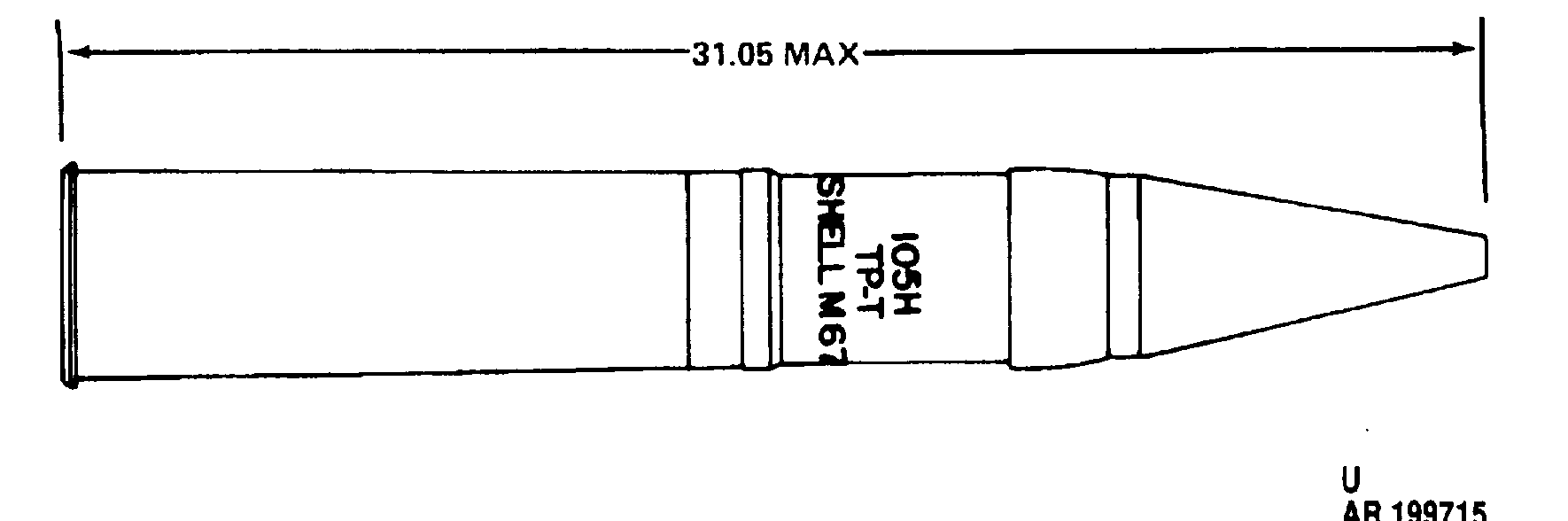
Description
This cartridge is used for training in marksmanship.
The projectile consists of a boat tailed steel body fitted with a steel windshield and gilding metal rotating band, The windshield is a hollow steel cone fitted to the front of a steel adapter. The adapter is threaded into the front end of the projectile, and retains a copper conical liner in the projectile cavity. The projectile cavity contains an inert filler instead of a shaped HE charge as in the service projectile. An empty fuze body with a live tracer is threaded into the base of the projectile. The complete projectile assembly is a free fit in the cartridge case. The cartridge case contains a percussion primer assembly and a single propelling charge increment. The base of the cartridge case is drilled and the primer assembly is pressed into the base. The percussion primer assembly consists of a percussion ignition element and a perforated flash tube containing black powder. The single increment bag is assembled into the cartridge case around the primer assembly.
The projectile is blue or black with white markings
Functioning
The weapon firing pin strikes the percussion primer which ignites the black powder in the primer. The primer ignites the propelling charge uniformly through the perforations in the primer tube and also ignites the tracer. The rotating metal band around the projectile engages the rifling in the barrel to impart spin to the projectile for in-flight stability. Expanding gases from the propelling charge force the projectile through the barrel with the velocity required to reach the target. The tracer burns for a minimum of 3 seconds during projectile flight. The projectile is non-functional, because it is an inert practice round lacking the penetrating capability of a service round.
Hazardous Components
Filler - Inert
Tracer - M5A2B1
Propelling charge - M1 (1.54 lb, 0.7 kg)
Primer - M28A2, M28B2
Physical Data
Length, overall - 37.06 in, 941.3 mm
See Also
Source(s)
TM 9-1300-203, Artillery Ammunition (1967)
