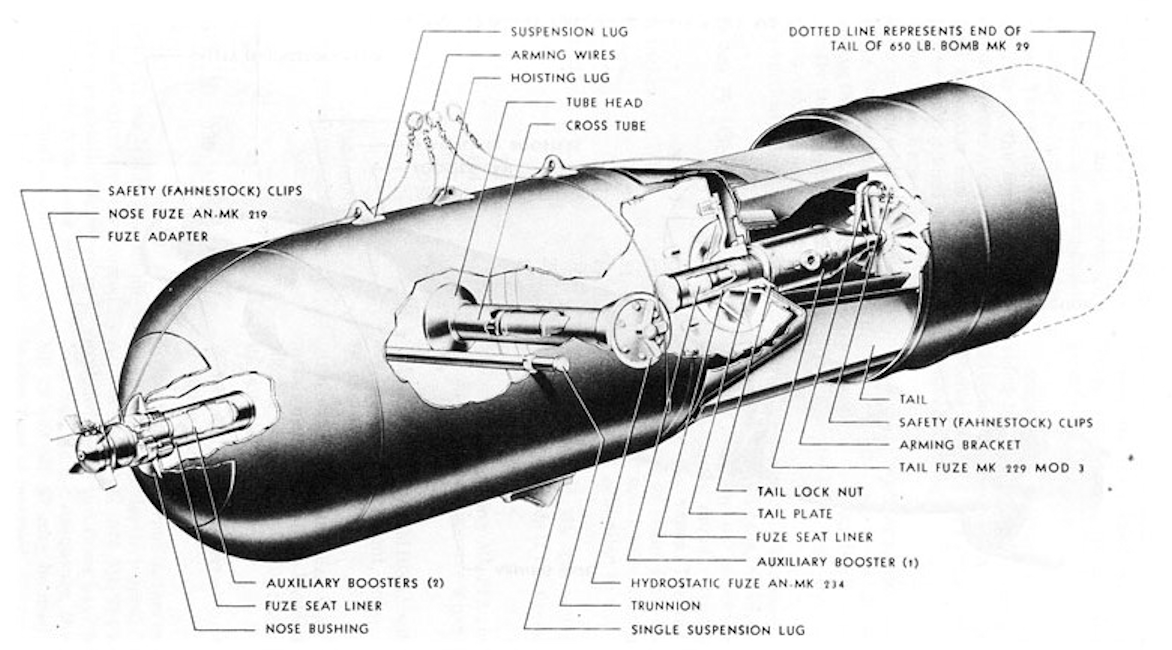
Description
These bombs are manufactured with a hemispherical nose reinforced with a steel disc. The suspension lugs are reinforced with a steel strip. A flat-nose attachment, in the shape of a bucket and fitting down under the nose of the bomb, can be used to improve underwater trajectory. The vacant spaces are then filled with plaster of paris. These attachments increase the weight by 72 pounds.
Horizontal suspension is provided by the usual two suspension lugs, with threaded holes on each side 90° removed to receive trunnion lugs for the displacement gear of dive bombers.
The bombs are painted olive drab or grey over all, with an 11-inch yellow disc between the two suspension lugs. They may be light grey over all.
Four sheet-steel vanes are welded to the tail cone, which is secured to the body by a locking nut screwing onto the rear of the body. An annular strut is used around the rear of the vanes. The tail of the Mk 37 was shortened by seven inches so that the Tail Fuze Mk 229 could arm more readily. Otherwise, the tail is similar to that of the Mk 29.
An extender is supplied with each bomb to permit installation of the Hydrostatic Fuze AN- Mk 221 or AN-Mk 231 in the longer athwartships tube.
The Mk 29 is converted to the Mk 37 by replacing the tail.
Because of numerous instances in water crash landings where depth bombs fuzed with the Athwartship Fuze AN-Mk 224 or AN-Mk 234 exploded, these two fuzes have been suspended from use. As a consequence, the Depth Bombs Mk 29 and Mk 37 may be used only if a nose impact fuze is installed.
Hazardous Components
The Mk 29 and Mk 37 both contain TNT (464 lb, 210.9 kg).
See Also
Tail, Hydrostatic, Mk 229 Mod 3
Tail, Hydrostatic, AN-Mk 230 Mod 3 - 6
Source(s)
OP 1664, Volume 2 - US Explosive Ordnance (1947)
USNBD - Bombs and Fuzes, Pyrotechnics (1945)
TM 9-1904, Ammunition Inspection Guide (1944)
