Description
This bomb was designed to take the place of both of the improvised No. 6 Mk 1 land, and type 1 No. 6 Mk 1 land, bombs. It is of wooden construction throughout to save steel, and proves itself equal to the other two bombs in effectiveness in Japanese tests. Exact dimensions are not available, but the following data is known.
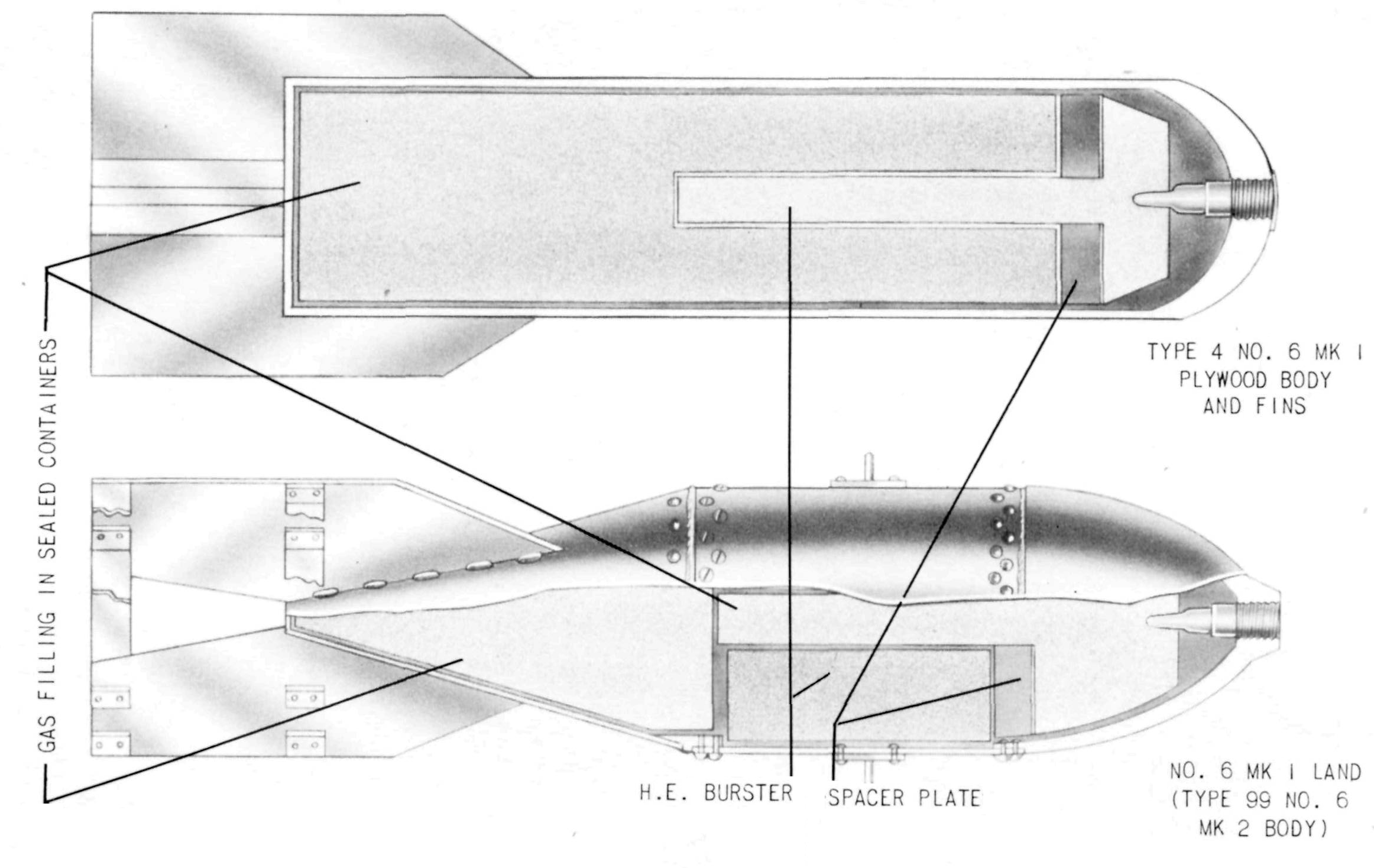
The barrel, nose section, and tail fins of the bomb are constructed of light plywood, molded into proper shape. A steel adapter is provided in the nose to take a standard Navy instantaneous fuze and gaine. The barrel of the bomb is cylindrical, with no cone at the tail. It is reinforced with bands of plywood. The tail fins are of standard shape, and are braced with steel struts. The nose section of the bomb is a wooden block, slightly rounded, and fitted into the barrel.
Chemical filling for the bomb is contained in a cylindrical can with a central pocket at its forward end to receive the central burster charge. At the forward end of the filling can is a spacer disk. An explosive nose charge is provided at the extreme forward end of the bomb and extends back through the spacer disk and into the central pocket in the chemical filling can. It is designed to prevent the chemical filling from collecting in the crater, and to spread it.
The Mk 1 bombs have never been recovered outside of the Japanese homeland, indicating that there was never any immediate intention of their use, and the small number of bombs of this type found in Japan indicates that the Japanese were inadequately prepared to initiate gas warfare.
The data on these bombs is the result of incomplete investigation, and must not be considered as specific, accurate information.
Hazardous Components
Mustard thickened with metha crylates and poly-vinyl alcohols.
See Also
General Information, Japanese Navy Bombs
Bomb, 60 kg Chemical, No. 6 Mk 1 Land
Bomb, 60 kg Chemical, Type 1 No. 6 Mk 1
Source(s)
