Description
Gray overall with a green tipped nose and a yellow band aft of the green. Yellow band on the tail.
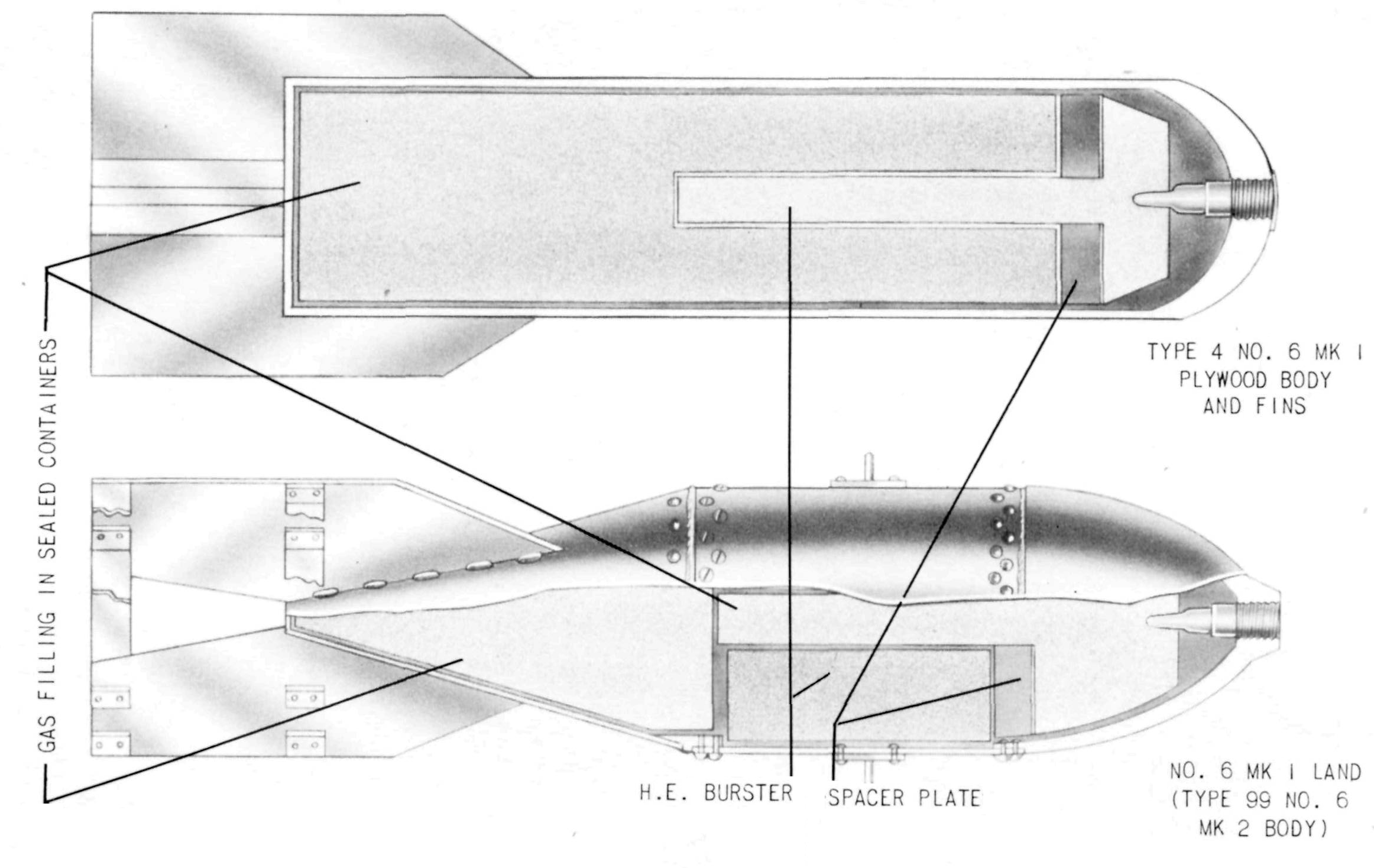
The chemical fillings for these bombs are contained in cans which fit inside the bomb casing, and are sealed in place with paraffin. Two cans were used for each bomb; a conical can which fits into the tail cone, and a cylindrical can with a channel down its center to provide space for the central explosive burster charge. Besides the central burster charge, a nose charge is provided, separated from the forward end of the gas containers by a spacer disk. The nose charge is designed to have the effect of forcing the spacer disk and chemical filling back out of the crater, and help to spread it.
These bombs are capable of being filled with any suitable gas, although the standard filling is mustard gas. According to Japanese statement, attempts by Japanese chemists to produce new types of gas failed to improve on types already in common production.
The Mk 1 bombs have never been recovered outside of the Japanese homeland, indicating that there was never any immediate intention of their use, and the small number of bombs of this type found in Japan indicates that the Japanese were inadequately prepared to initiate gas warfare.
The data on these bombs is the result of incomplete investigation, and must not be considered as specific, accurate information.
Hazardous Components
Mustard thickened with metha crylates and poly-vinyl alcohols.
See Also
General Information, Japanese Navy Bombs
Bomb, 60 kg Chemical, Type 1 No. 6 Mk 1
Bomb, 60 kg Chemical, Type 4 No. 6 Mk 1
Bomb, 60 kg Ordinary, Type 99 No. 6
Source(s)
