Description
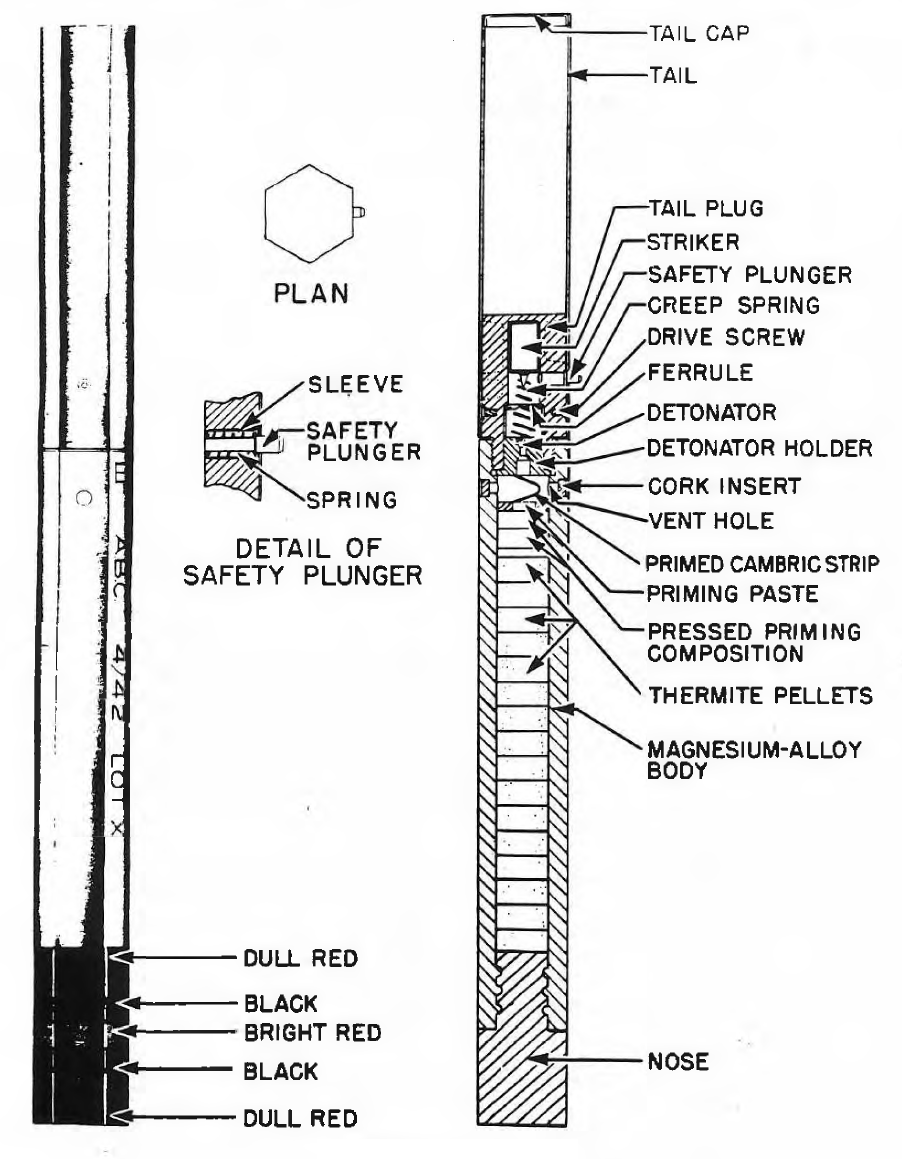
The Bomb Mk III consists of a hollow, magnesium-alloy body, at one end of which is a cast iron or steel nose; the body being cast onto the nose during manufacture. A magnesium alloy tail plug, which may be of solid or open construction, is screwed into the other end of the body. Fixed to the tail plug by two drive-screws is a tin plate tail closed by a tail cap.
The tail plug houses a striker, creep spring, ferrule having four tabs, and a brass cap holder containing a 1.7-grain detonator. When the bomb is packed in its case, movement of the striker towards the detonator is prevented by a spring-loaded safety plunger housed in a sleeve fitted into the tail plug. Two vent holes, plugged by cork inserts, are provided in the body to communicate with the space between the cap holder and the filling of the bomb. A strip of primed cambric is located in this space. The Mk IIIE is identical to the Mk III, except for a black powder exploder charge, just abaft the nose plug in the body cavity, which replaces a small quantity of the thermite filler.
The bombs are carried in the Small Bomb Container, or in a Cluster Projectile.
The I.B. 4 lb Mks II and IIE are similar to the Mk III and Mk IIIE, but have the following differences. The bomb bodies have a smaller bore, and the bomb bodies have four cork plugged vent holes. The tail plugs and cap holders are of solid magnesium alloy, and the noses are of steel.
The 4 lb. Bombs Mks I and IE are similar to the Mks II and HE respectively, but have only a 1.62-grain detonator and are 21.4 in. long.
The 4 lb. X, with 2- and 4-minute delays, Mk I is similar in construction to the Mk III, except that a C.E. exploder is contained in the steel nose plug; this exploder being initiated after delay of either two or four minutes. The letter “X” is stamped on the outside followed by a number “2” or “4” indicating which delay is incorporated in the bomb. The marking bands are the same as on the Mk IIIE, except that the red band between the two black bands is 1 in. wide instead of in., and the base of the tail is not painted red.
Functioning
No information about functioning.
See Also
British Bombs - Designation and Classification
Source(s)
OP 1665, British Explosive Ordnance (1946)
