Description
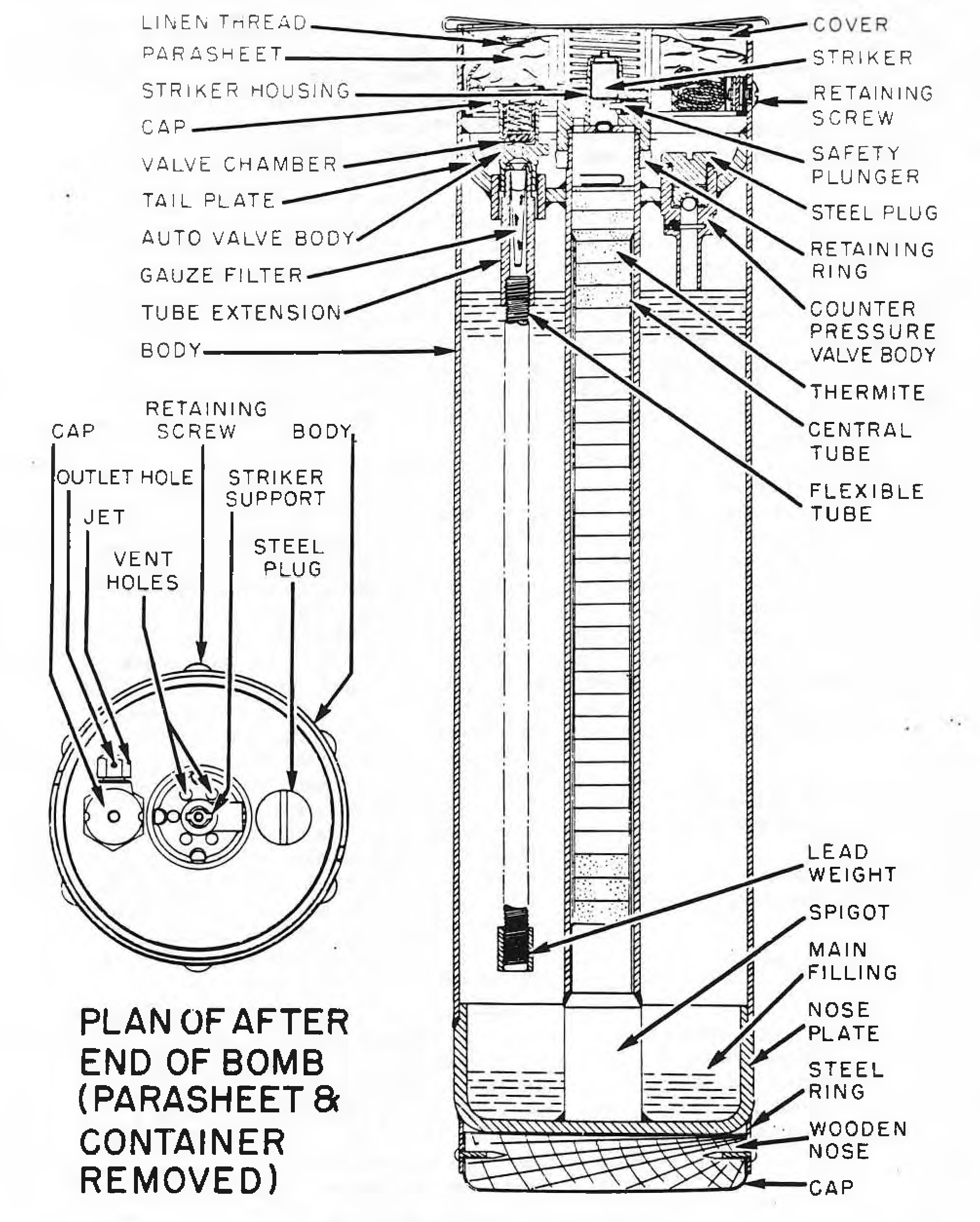
The bomb consists of a cylindrical steel body with a dished steel nose plate having a central spigot welded on, a steel ring welded to the nose plate, and a wooden nose covered by a thin metal cap and secured by screws to the ring. A tail plate is welded, near the other end of the body, and a steel central tube, projecting through the tail plate, is welded to the tail plate and the spigot on the nose plate. A magnesium-alloy striker is screwed to the central tube and retains a detonator holder in position. The striker is supported by a two-armed brass cross which engages the top of the housing. A spring-loaded safety plunger, contained in a sleeve, projects into the path of the striker. The safety plunger is held in position by a retaining sleeve, which is secured to the parasheet container.
An automatic valve is fitted to the tail plate and has an auto-valve body screwed into a socket welded into the tail plate. A tube extension, screwed into the inner end of the auto valve body, holds a flexible tube, which extends to within three inches of the bottom of the bomb. A jet having its outlet hole pointing vertically out of the tail is screwed into the side of the auto valve body. The valve chamber houses a spring-loaded piston having a rubber sealing disk at its inner end, which normally seals the central hole in the valve body.
The parasheet is housed in a container held in the tail end of the bomb body by six retaining screws, and its rigging lines are anchored to the container. The container is closed by a loose metal cover held in position by the end plates of the cluster projectile. A safety pin retaining sleeve, secured to the cover, is fitted into a central guide tube in the parasheet container, and houses a spring retainer in which is a compressed spring.
Carried in batches of 14 in Cluster Projectiles, 500 lb, No. 4 Mk I.
Functioning
No information about functioning.
See Also
British Bombs - Designation and Classification
Source(s)
OP 1665, British Explosive Ordnance (1946)
