Description
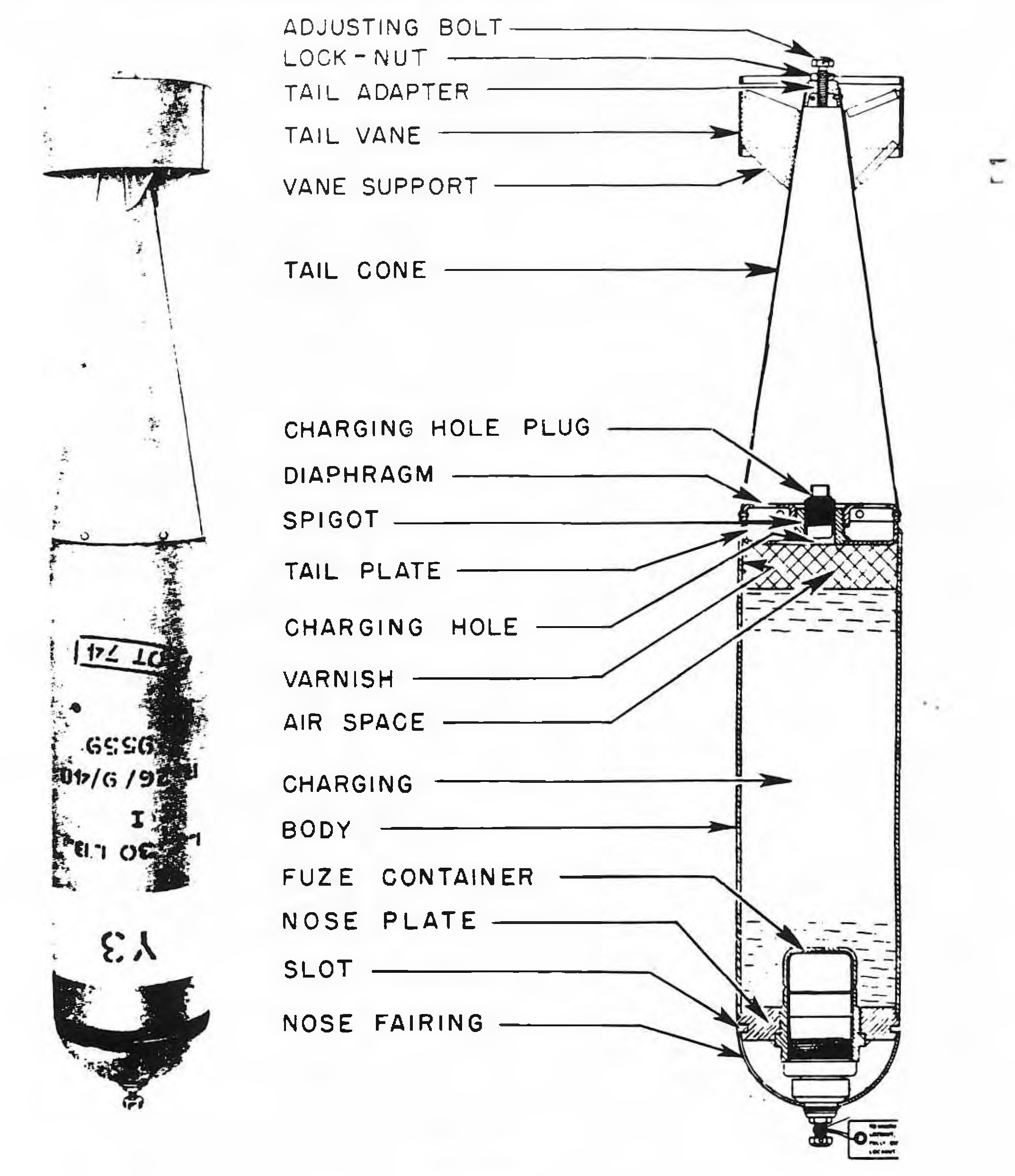
The bomb consists of a steel, tubular body to which is welded a steel tail plate, a steel nose plate, and a nose fairing. The fuze container is screwed and welded into the nose plate.
A spigot, having a central charging hole, is welded into the tail plate and closed by the charging hole plug. The spigot has external threads onto which the tail is threaded.
The inside of the bomb usually has a protective coating of bakelite varnish to retard corrosion. The external areas around the charging hole plug and fuze container are painted with khaki detector paint, which turns red when exposed to gas.
The tail consists of a tinplate cone, the apex of which is surrounded by a cylindrical tail vane connected to the cone by vane supports. A diaphragm, having a threaded hole by which the tail is threaded onto the spigot, closes the base of the tail; and a tail adapter closes the apex of the tail. An adjusting bolt, having a rounded head, is screwed into the tail adapter and locked in position by a lock nut.
The Mk I and Mk IM can be carried in the 250 lb. Small Bomb Container. The Mk IM can be used on a Light Series bomb carrier when fitted with a suspension band.
The Bomb Mk I may be fitted with retarding equipment consisting of a flat nose cap, which replaces the nose fairing, and a flat steel retarder plate, which is held in place on the tail by the adjusting bolt and lock nut.
The Mk IM bomb is the same as the Mk I except for two locating pieces, welded to the body, which serve to locate a suspension band.
Functioning
On impact with a soft target the fuze functions, and, after a short delay during which time the bomb has come to rest, ignites the gunpowder ejection charge, thus blowing off the tail and tail plate and ejecting the chemical filling. On impact with a hard target, the bomb will normally break up and distribute the charging before the ejection charge functions.
See Also
British Bombs - Designation and Classification
Source(s)
OP 1665, British Explosive Ordnance (1946)
