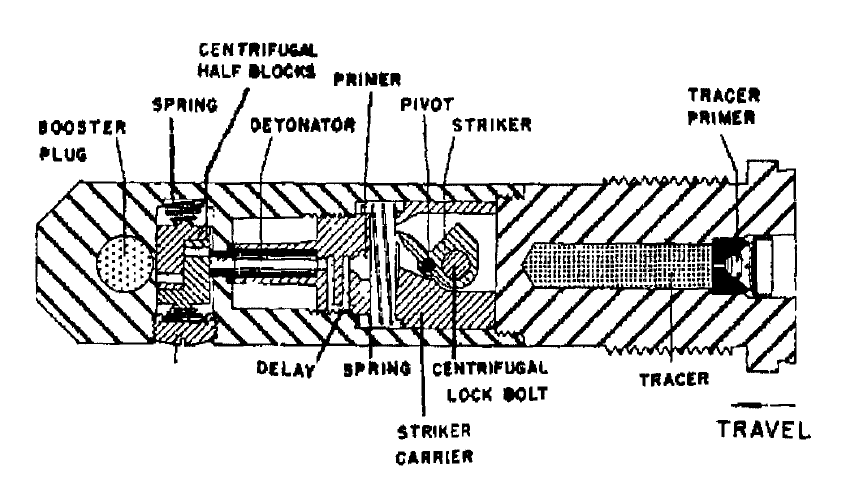
Description
This fuze consists of two major parts: (1) a tracer head, threaded externally to screw into the base of the projectile and containing the tracer primer and pyrotechnic components: (2) the fuze body, which houses the Semple striker and carrier unit, the primer delay detonator assembly, the centrifugal half blocks, and the booster.
In the unarmed position, the striker, which is pivoted in the striker carrier, is held offset from the primer by a pair of centrifugal lock bolts. These bolts are housed in the striker carrier and engage the hole in the weighted end of the striker. Also, in the unarmed position, the detonator is separated from the booster by a pair of centrifugal half-blocks. Each half block is TNT stemmed to form a booster lead-in, but the two stemmed portions of the half blocks are out of alignment in the unarmed position, providing a safety interruption in the explosive train. Additional safety is provided by encasing the detonator in,a small expansion chamber. Accidental explosion of the detonator will expend itself in the expansion chamber and will not fire the stemmed half-blocks or the booster.
Because of the shape of the striker, the force of the initial acceleration prevents centrifugal force from aligning the striker while the projectile is still in the bore of the gun. When acceleration ceases, centrifugal force revolves the pivoted striker to the armed position.
Functioning
When the projectile is fired, the tracer primer functions and ignites the tracer element in the base of the fuze. Centrifugal force causes the centrifugal lock bolts and the centrifugal half-blocks to move outward against their springs. This aligns tile booster lead-ins in the half blocks and unlocks the pivoted striker. Since the striker is heavily weighted on its lower end, centrifugal force rotates the striker about its pivot and brings the striker point into alignment with the primer. On impact, the striker carrier moves forward against its spring, bringing the striker against the primer, which fires the delay element and the detonator. The flash from the detonator initiates the stemmed lead-ins in the half-blocks, the booster charge, and finally the projectile.
Hazardous Components
No information about hazardous components.
See Also
Nothing else to see.
Source(s)
MIL-HDBK-146, Fuze Catalog (1982)
OP 1664, Volume 1 - US Explosive Ordnance (1947)
