Description
The apparatus consists of a housing canister, support parachute, bomb, steel cable, and towing parachute.
The cylindrical housing canister is a metal tube, the open end of which is closed by a lid. A hinged metal flap is attached to the lid to insure its release when the apparatus is dropped. A lid-retaining assembly holds the lid and its flap in place until the bomb is dropped.
The support parachute's shroud lines are tied to an attachment ring which is connected to the double snatch link of the bomb fuze by circlips.
The discus-shaped bomb has a central fuze hole, and a rolled edge to facilitate penetration. The fuze is secured in place by a nut. The bomb is filled with C.E./TNT.
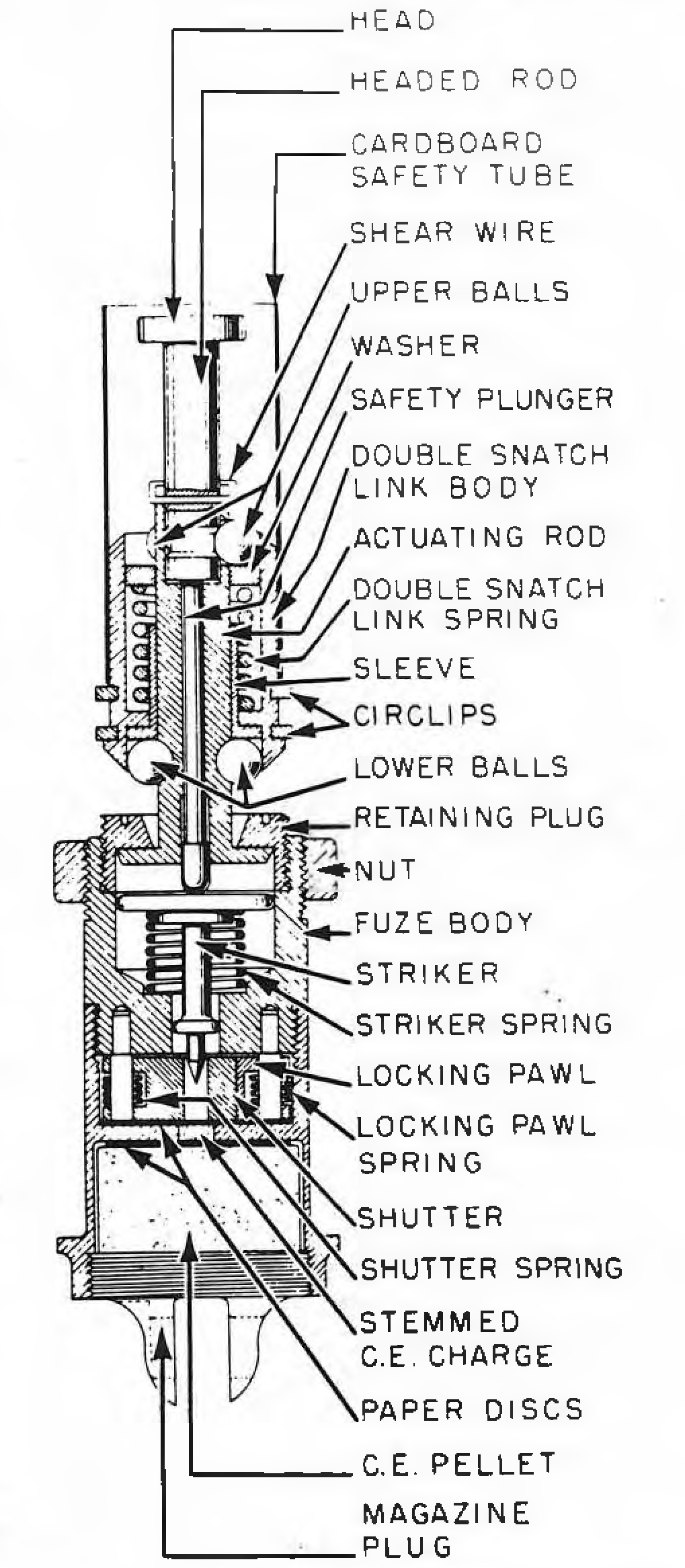
The fuze incorporates an all-ways acting striker mechanism, a double snatch link, and a CE filled magazine, which is screwed into the base of the fuze and closed by a plug. This plug has an eye to which the cable is attached. The fuze body houses a striker, creep spring, and shutter. When the detonator in the shutter is held out of line with the striker by the striker point engaging a hole in the shutter, the fuze is unarmed. If the striker point is withdrawn from this hole, the shutter is moved into place by its spring and held in alignment by a spring-loaded locking pawl. The striker is retained in the shutter hole against the pressure of its creep spring by a safety plunger, which is retained in position in the actuating rod by a headed rod. A shear wire and the upper balls of the snatch link connect the headed rod and the actuating rod. The flanged head of the actuating rod is housed in the fuze body.
The double snatch link consists of a body housing the actuating rod. which carries an upper and lower set of balls, a washer, sleeve, and compressed spring. The upper balls bear on the washer, which presses against the upper j end of the spring, and the lower set of balls bear against the under side of the flanged end of the sleeve. The parachute attachment ring is joined to the snatch link body by two circlips.
The support parachute, which is packed and held together with rubber bands so it will open only on sharp impact, is attached to the fuze eye by a one hundred foot cable.
Functioning
When the apparatus is released from the plane, the lid is blown off and, acting as a pilot chute, withdraws the support parachute, followed by the bomb, cable, and towing parachute. The cannister falls away and the cable assumes a vertical position.
The opening of the support parachute imparts a jerk to the double snatch link, which then releases the lower set of ball.'. When the cable is completely unwound, the upper set of ball.- is ejected and the juncture of the fuze to the support parachute is transferred to the shear wire.
When the pursuing enemy plane collides with the cable, another jerk is transmitted to the bomb and support parachute. The ends of the shear wire are cut by the snatch-link washer, which then engages the headed rod. and again cuts the shear wire to release the safety rod and arm the fuze. The support parachute and snatch link are then freed from the assemblage. The shock of impact also opens the towing parachute. which prevents the cable from slipping over and away from the plane. The bomb is whipped against the plane, and its hard edges penetrate the skin. Penetration causes deflection of the actuating rod, which forces the striker into the detonator and explodes the bomb.
See Also
British Bombs - Designation and Classification
Source(s)
OP 1665, British Explosive Ordnance (1946)
