Description
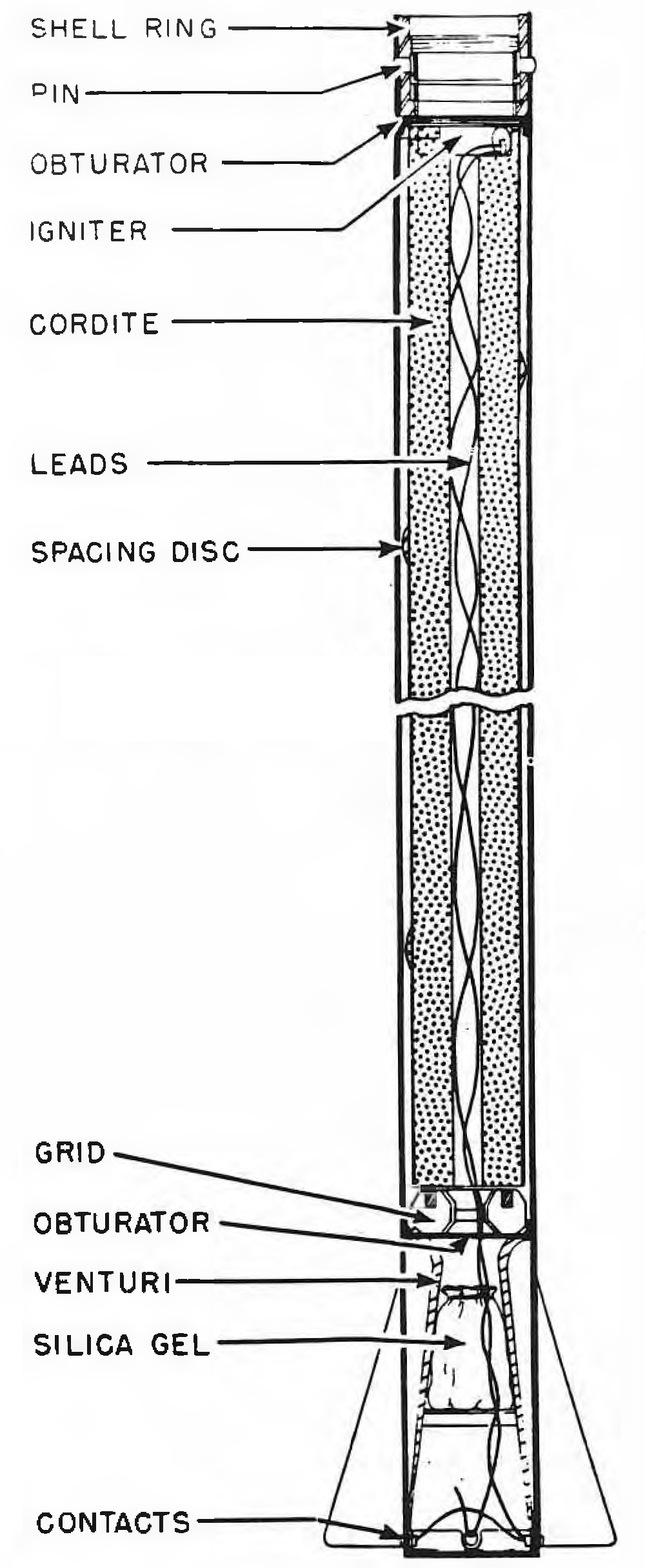
These motors are identical, except that the Mk I contains a tubular grain, while the Mk II grain is cruciform in shape. The motor body consists of a steel cylinder, slotted at the tail end to receive the four tail fins. A shell ring, fitted in the head end of the body, is internally threaded to receive the base of the shell, and has eight holes to correspond with those in the motor body. Locking pins, flanged on their inner ends, are inserted through these holes and are retained in position by two circular band springs. A copper- or cadmium-plated steel obturator is placed in the rear of the shell ring and is separated from the propellant grain by a cardboard disc and two cardboard washers.
The propellant grain is castellated at the forward end to receive the igniter, and a washer of dummy cordite, attached to the base of the grain, bears against the ring of the grid. Spacing discs and tabs are attached to the exterior of the cordite grain by a special cement.
The igniter consists of a 10-gram charge of magnesium with an electric squib enclosed in a paper tube. The insulated electric leads pass through the central channel of the cordite grain to the contacts at the after end of the motor body.
The tail obturator, positioned between the grid and the venturi tube, is made in the form of a steel cup with a central perforation. The steel venturi tube is attached to the motor body by screws and welding, and contains a small bag of silica gel as a moisture-proofing measure. The leads from the igniter are connected to the four contacts around the outside of the motor body, so positioned that they make contact with the knife edges on the launcher, regardless of the angle at which the rocket is loaded.
Proposed new nomenclature for the rocket motors is as follows: Motor, Rocket, 3-in., No. 1 Mk I for Propelling Tail, Rocket, 3-in., Mk I, and Motor, Rocket, 3-in., No. 2 Mk I for Propelling Tail, Rocket, 3-in., Mk II.
Functioning
No information about functioning.
See Also
Source(s)
OP 1665, British Explosive Ordnance (1946)
