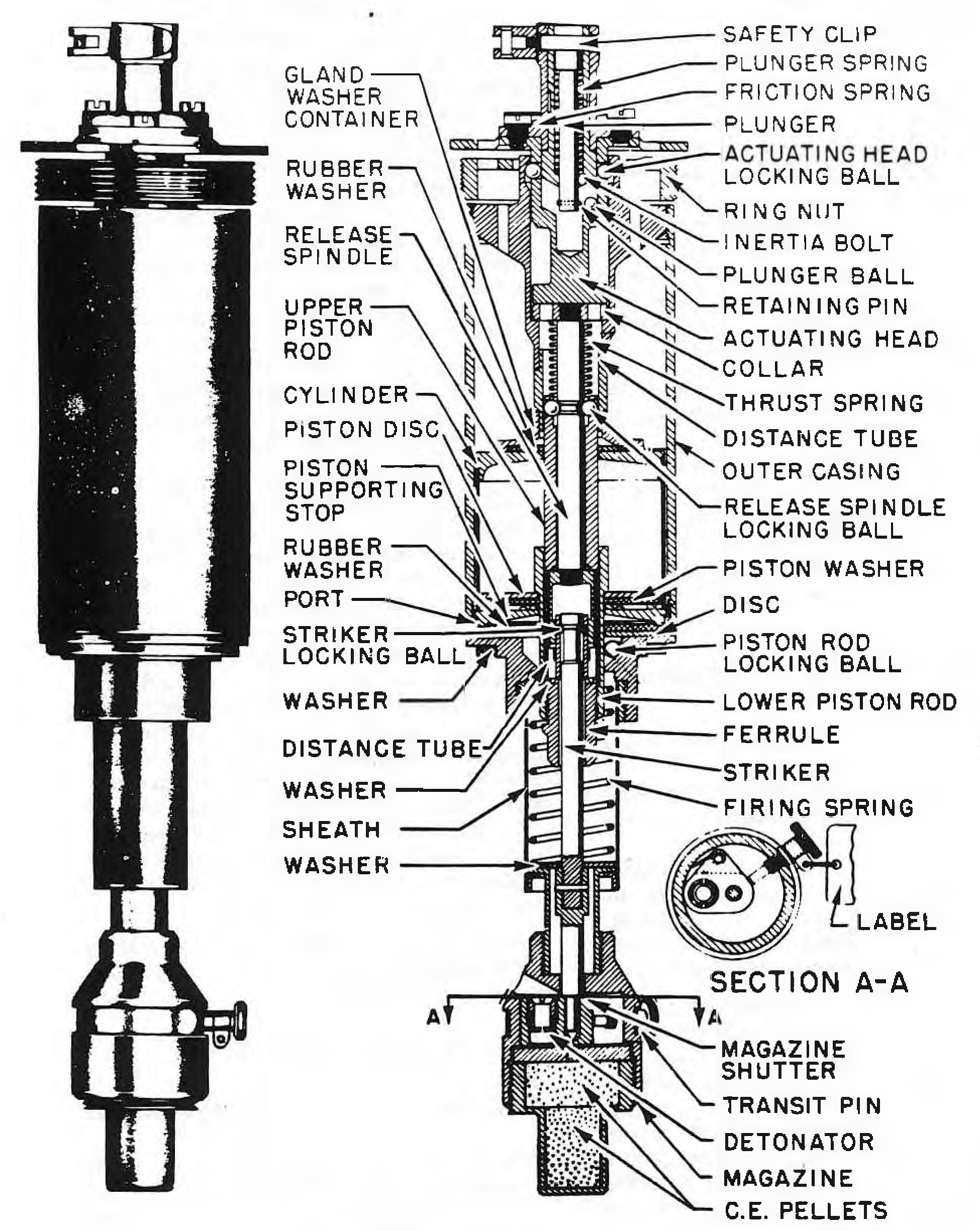
Description
The Bomb Fuze No. 850 Mk I is a hydrostatic arming, contact firing bomb fuze specially designed for use in the 250 lb buoyancy bombs. The fuze itself consists of 'two portions, the upper portion housing the hydrostatic mechanism, and the lower portion forming the magazine.
The upper portion of the outer casing houses the actuating head. The head is locked to the casing by a ball lock, which is freed on impact with water. The cylinder is cf slightly smaller diameter than the outer casing, leaving a small annular space between the cylinder wall and the casing. The lower end of the cylinder is in the form of a disc and is contained in the lower end of the outer casing to which it is soldered. A piston-supporting stop, consisting of a metal disc with protrusions on both faces, clamps a rubber washer in position and also supports the cylinder wall and the piston. The upper protrusion of the piston-supporting stop is provided with ports, which, together with ports formed in the lower end of the cylinder wall, connect the space below the piston with that between the cylinder wall and the outer casing.
The piston consists of a metal disc with a central hole into which the lower portion of the piston rod is inserted. This portion of the piston rod has a shoulder at its upper end by which the piston rod is raised when the piston is forced up the cylinder by hydrostatic pressure. The piston rod, which is hollow, is made in two sections. The upper section of the rod houses the release spindle, to which it is locked by a ball. The lower portion of the piston rod is threaded internally to accommodate a screwed ferrule, which houses the upper end of the striker. The upper end of the striker is locked to the ferrule by a ball lock. The ferrule is bevelled at its lower end, and forms part of a lock that prevents the return of the piston after the fuze has been armed. The lock consists of a locking ball, housed in a conical recess formed in the lower portion of the outer casing. A washer and a distance tube are inserted in the lower portion of the piston rod to support the upper section of the piston rod.
The striker is locked to the screwed ferrule in the lower section of the piston rod by a ball lock, and protrudes through the lower end of the ferrule. The lower end of the striker is housed in a blind hole in the spring-loaded shutter of the magazine, when the fuze is in the safe position. The firing spring, encased in a sheath, is interposed between the lower end of the outer casing and a washer supported by the striker shoulder.
A collar is screwed to the top of the release spindle and forms a bearing surface for the lower end of the actuating head. The thrust spring is interposed between this collar and the upper portion of the piston rod. The actuating head is contained in the upper portion of the outer casing, to which it is locked by a ball lock. The actuating head is bored axially to house a hollow inertia bolt, which accommodates a spring-loaded plunger. This plunger is retained in position by the fuze safety clip, which passes through the inertia bolt and the actuating head. A retaining pin prevents ejection of the plunger by its spring when the safety clip is withdrawn.
A light friction spring is fitted to the actuating head and bears on the inertia bolt. This spring engages in a groove in the inertia bolt when the bolt moves downwards.
The magazine, containing two C.E. pellets, is attached to the lower end of the sheath surrounding the firing spring, and is arranged so that the fuze can accommodate itself to any tolerance in the length of the central tube and exploder column in the bomb. A spring-loaded shutter, which carries a detonator, is incorporated in the magazine. The shutter is held in the safe position by the striker and by a transit pin during storage and transit.
The fuze is retained in position in the bomb by a ring nut situated between the flange on the actuating head and the upper portion of the outer casing. A rubber washer around the lower portion of the outer casing forms a watertight seating, when the fuze is assembled in the fuze pocket of the bomb.
The Fuze No. 850 Mk II differs from the Mk I in that the safety clip is replaced by a cotter pin, which pierces both the plunger and the actuating head.
Functioning
No information about functioning.
See Also
Nothing else to see.
Source(s)
OP 1665, British Explosive Ordnance (1946)
