Description
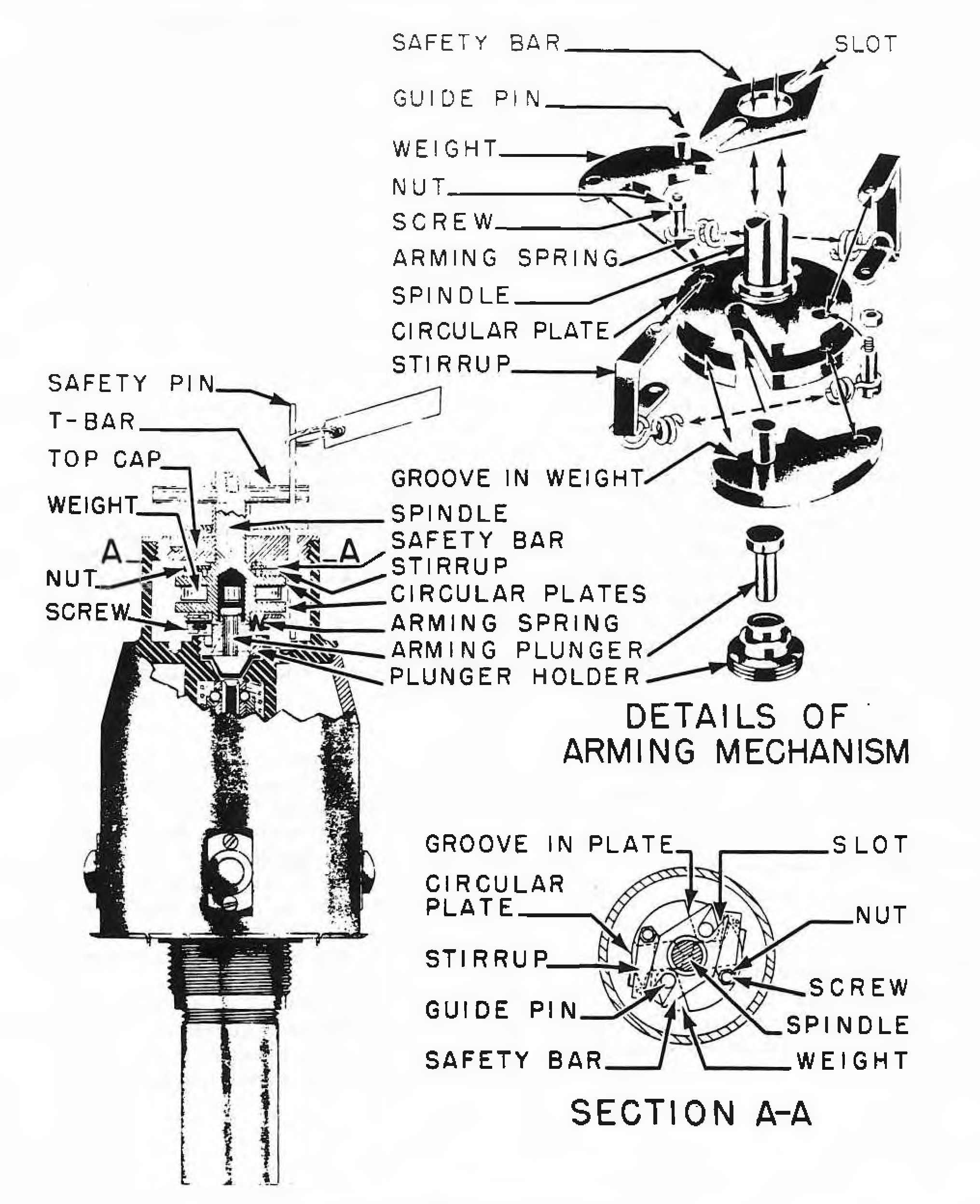
This fuze is similar to the Fuze No. 895 Mk I, except that the method of arming is altered. The Fuzes No. 895 Mk II are armed by the rotation of the vanes and tie-rod incorporated in the standard British tail assembly. The tie-rod engages the T-bar of the fuze and rotates the centrifugal arming mechanism. This mechanism consists of a spindle, to which the T-bar is attached, with its lower portion enlarged and grooved to form two circular plates located one above the other about Vi inch apart. The central column of this spindle is drilled from the bottom to allow insertion of the arming plunger, which is supported by a plunger holder threaded into the top cap of the fuze. Two semicircular weights are located between the two plates formed from the enlarged portion of the spindle. A projecting point on the flat edge of each of these weights blocks any upward movement of the arming plunger. Each weight is held inward by a U-shaped stirrup. The stirrups themselves are each held tightly against the sides of the plates by an arming spring. Two screws, located 180° apart, penetrate the circular plates of the spindle. One end of each arming spring is fastened to one of these screws, and the other end of the spring is attached to one of the stirrups. Each screw also serves as a pivot for one of the weights and the corresponding stirrup. A nut threaded to the upper end of each screw completes this assembly. A guide pin is set into the top surface of each weight. Each pin rides in a groove cut in the upper circular plate on the spindle and also is located in a slot cut in each end of a diamond-shaped safety bar. This safety bar fits freely around the upper portion of the spindle. A safety pin engages the T-bar, penetrates the cover of the fuze, and passes down along the outside of one of the stirrups. The safety pin thus holds one of the weights securely in position during storage and transit.
The designation given to Fuzes No. 895 Mk II includes the nominal depth setting. The Fuze No. 895/18 Mk II, having an 18 ft. depth setting, is used in the A.S. 100-lb. Bomb Mk VI, and replaces the No. 895A Mk I. The Fuze No. 895/23 Mk II, having a 23-ft. depth setting, is used in the A.S. 250-lb. Bomb Type C. The Fuze No. 895/30 Mk II, having a 30-ft. depth setting, is used in the A.S. 600-lb. Bomb Mk I.
The greater depth settings are accomplished by substitution of heavier striker springs, or by an additional spring placed between the top cap of the fuze and the spring housing.
Functioning
No information about functioning.
See Also
Nothing else to see.
Source(s)
OP 1665, British Explosive Ordnance (1946)
