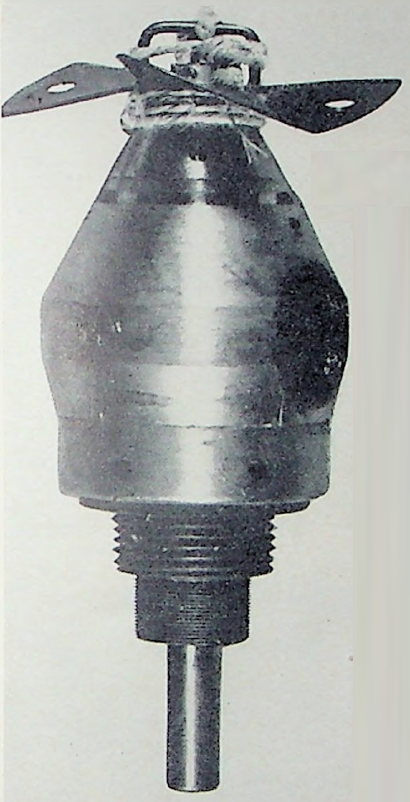
Description
The B-8(a) is a Japanese Army mechanical impact, always acting tail fuze. It may be used in the 30 kg, 100 kg, 250 kg and 500kg anti-submarine bombs. The fuze is brass. This fuze can be found with the A-8(a) or A-8(b).
The fuze consists of an upper and lower fuze body. Upper fuze body houses the allways action unit, arming spindle and arming vane assembly. The lower fuze body which is threaded internally to receive the upper body houses the lower part of the delay element. It is threaded externally at one point to screw into the fuze pocket and below that to accommodate the booster tube. It is threaded internally at the after end to receive a standard Army gaine.
Upper fuze body is pierced centrally by a threaded hole which houses the arming spindle. Three bladed arming vanes fit over the top of the spindle and are held there by a vane nut staked in place. Just above the dome cavity is a threaded segment of the arming spindle. The spindle extends down into the cavity.
The all-ways action unit is housed in the cavity drilled across the upper fuze body ending concavely in a dome. The open end is closed by a threaded plug with a similar dome on the inside. This cavity is filled by the striker and primer carrier assembly, the outer ends of which are domed. This assembly is similar to the all-ways action unit utilized in the A-7(a). The assembly fits across the fuze and the arming spindle fits down through a hole in the striker holding the primer and striker apart. A spring also holds the two apart. A flash hole in the bottom of the cavity leads to delay train which is threaded into the base of the upper fuze body. This in turn leads through the lower fuze body to the gaine.
Because this fuze has the standard B-1(a) size threads, it could be used in bombs up through 100 kg and with the adapter in B-4(a) size fuze pockets.
Functioning
The safety fork is withdrawn and the vanes rotate causing the arming spindle to rise in the central hole and withdraw from the all-ways action unit. This leaves the striker and primer carrier separated only by the creep spring. On impact at any angle the striker and primer are cammed together by the force of inertia. The flash from the primer passes through the flash holes, ignites the delay which in turn ignites the relay on top of the gaine.
Hazardous Components
Primer, 4-5 second delay, standard Army gaine, boosterPrimer, 4-5 second delay, standard Army gaine, booster.
Physical Data
Length, overall - 5.39 in, 136.9 mm (less booster)
Width, overall - 2.25 in, 57.2 mm (approx)
See Also
Nose, A-8(a), Type 4 Two Second Delay
Nose, A-8(b), Type 4 Two Second Delay
Tail, B-4(a), Type 92 for Large Bombs
Source(s)
OP 1667, Japanese Explosive Ordnance, Volume 1 (1946)
OPNAV 30-3M, Handbook of Japanese Explosive Ordnance (1945)
USNBD - Japanese Bombs & Fuzes (1944)
TM-E9-1984, Enemy Bombs and Fuzes, Section VII, Japanese Fuzes (1942)
