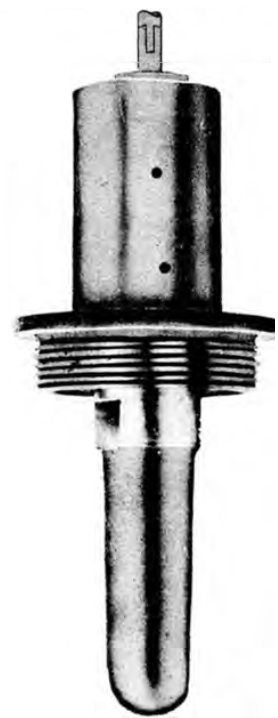
Description
This is a Japanese Navy mechanical impact tail fuze. it is used in the 1 kg antiaircraft bomb. The fuze is aluminum.
The fuze body which houses the striker is externally threaded at the base to screw into the bomb body and at the top for the body cap. The cap screws onto the body and is threaded to receive the arming spindle which further screws into the striker, holding it in position. There are three grooves in the striker, two of which act as air vents, and one as a keyway. In the unarmed position the striker is held in the safe position by a safety detent and the arming spindle. An arming wire passes through the vanes preventing rotation and extends down to lock the safety detent against the pressure of the safety detent spring. A thin metal disc attached to the arming wire and lying just over the vanes inside the circular tail brace acts as a drogue to withdraw the. arming wire when the bomb falls. When armed, the striker is held away from the detonator by a spring.
Functioning
When bomb is released from the container, the pressure of air against drogue forces it from bomb and withdraws the arming wire. The safety detent spring then ejects the safety detent from side of fuze. The vanes rotate and unscrew the threaded arming spindle, freeing the striker. (This spindle is threaded with a left-hand thread.) On impact, striker carries forward and drives the firing pin into the detonator.
Hazardous Components
Gaine similar to Navy Type 1 with primer, detonator, booster.
Physical Data
Length, overall - 2.3 in, 58.4 mm (less booster)
Width, overall - 1.75 in, 44.5 mm
See Also
Nothing else to see.
Source(s)
OP 1667, Japanese Explosive Ordnance, Volume 1 (1946)
USNBD - Japanese Bombs & Fuzes (1944)
TM-E9-1984, Enemy Bombs and Fuzes, Section VII, Japanese Fuzes (1942)
