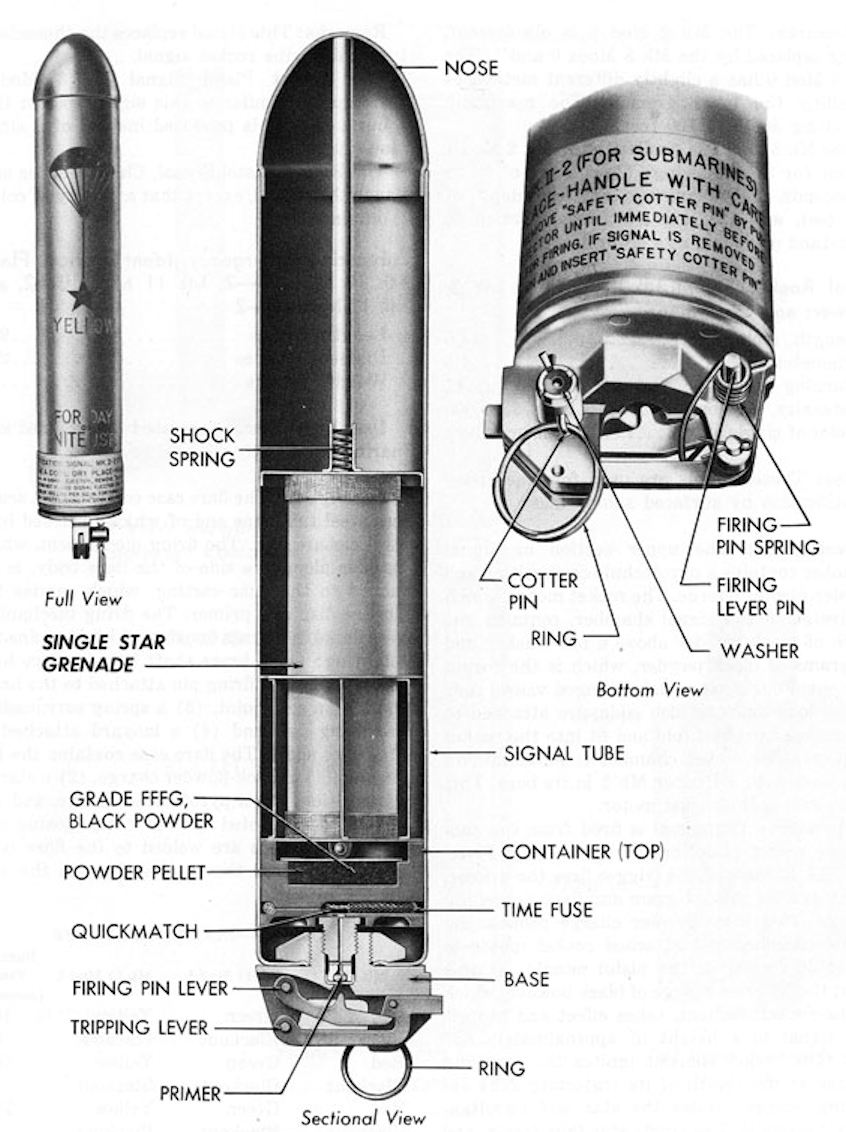
Description
These signals are used for submarine emergency identification, whether submerged or surfaced.
The signal consists of a cylindrical aluminum case containing the grenade type Pyrotechnic Candle Mk 3. The bottom end contains two delay elements. A single star candle is attached to a parachute by an asbestos cord.
Functioning
The shell is projected from the standard submarine emergency identification signal ejector, using compressed air as the propellant. The shell is fired by a lug at its base which projects beyond the side of the shell and rides in a groove in the ejector tube. As the shell is forced through the tube, the extended lug reaches the end of the groove just before the base of the shell passes the muzzle door. The tripping lever is pulled back, thereby cocking and releasing the firing pin lever and firing pin. The firing pin strikes the primer, and the Hash from the primer ignites a time fuse. The time fuse burns while the signal is rising to the surface. The delay ignites the grenade-ejection charge, which ejects the signal to a distance of approximately 250 feet. At the summit of the trajectory, the delay train flashes into the signal ejection charge and causes the parachute suspended star to be ejected.
See Also
Source(s)
OP 1664, Volume 1 - US Explosive Ordnance (1947)
USNBD - Bombs and Fuzes, Pyrotechnics (1945)
