Description
This rocket is fired from a hand firing rocket projector, and is initiated by a 30 grain percussion cartridge. The rocket is designed for rescue purposes on marine craft and for use by airfields situated in coastal areas as a means of contacting crews of aircraft which have crashed into the sea immediately after take-off.
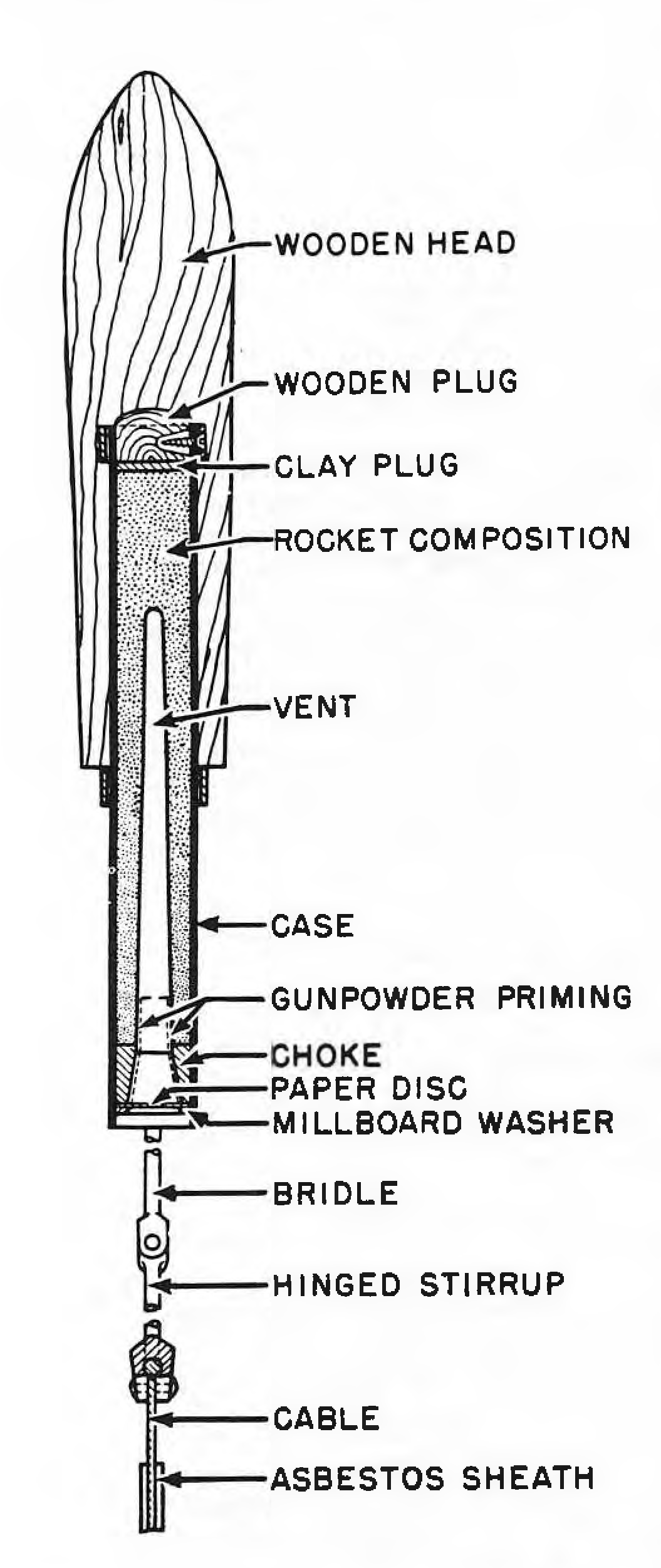
The rocket consists of a wooden head made in two halves, held together with screws, which engage the head of the rocket tube. The rocket propellant composition is contained in the tube, the nose end of which is closed by a wooden plug and a clay plug. The after end of the rocket tube houses a plaster-of-paris choke, which is covered by a millboard washer and an oiled paper disc. A conical vent is formed in the rocket propellant composition in line with a tapered hole in the choke. The end of the vent nearest the choke and the hole in the choke are coated with gunpowder priming.
A bridle with a hinged stirrup is attached to the rocket, and a tail consisting of a wire cable about 3 ft. long is secured to the stirrup. The part of the tail nearest the rocket is protected from the heat of the burning rocket composition by an asbestos sheath. The free end of the tail carries a loop for connection to a buoyant line.
The buoyant line consists of 250 yd. of orange colored cotton cord, which is specially treated so that it will float on water. It is coiled in a square cardboard container whose lid is secured by adhesive tape.
The wooden head is painted yellow overall, and filling and manufacturing information is stenciled on the head in black letters.
Functioning
No information about functioning.
See Also
Source(s)
OP 1665, British Explosive Ordnance (1946)
