Description
The 3.5-inch rocket flare was developed for use from surface ships, particularly motor torpedo boats. The illuminant candle produces an average of 800,000 candle power for approximately twenty nine seconds, The rocket motor carries the flare out 1,800 yards before ignition.
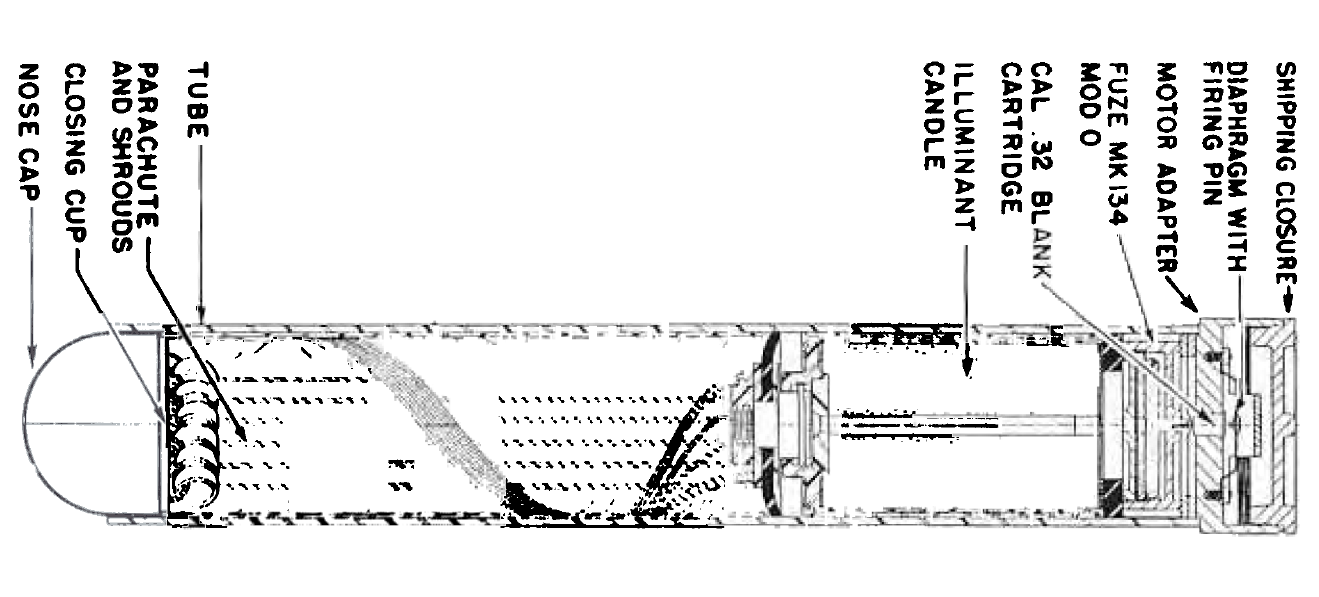
The flare consists of the followving major components: 3.25-inch Motor Mk 12 Mod 0, Mk 14 Mod 0, or Mk 14 Mod 1; 3.5 inch Head Mk 10 Mod 0, Mk 14 Mod 0, or Mk 15 Mod 0; and Body Load (Flare) Mk 7 Mod 0.
Head: All the heads are interchangeable and differ only in minor details, The 3.5-inch Head Mk 10 Mod 0 has a wooden nose piece held in place by three shear pins, while the Mk 14 Mod 0 and Mk 15 Mod 0 have a sheet-metal nose piece press-fitted in place. The Mk 15 Mod 0 is one inch longer than the other two.
The head consists of a 3.25-inch seamless steel tube which incorporates a 3.5-inch diameter closure adapter welded to the after end. This closure adapter carries a copper diaphragm plate with a firing pin, and serves as a chamber for the caliber .32 blank cartridge, which ignites the fuze. The balance of the head is taken up by the candle and parachute from the 4-inch illuminating projectile, the composition of the candle slightly changed to increase the candlepower in the shorter burning time.
Motors: The three motors are similar and interchangeable. The principal distinguishing feature of the 3.25-inch Motor Mk 14 Mod 1 is the use of welded-on launcher lugs replacing the lug bands employed on the earlier models. The motor housing is a 3.25-inch seamless steel tube containing a forward closure disc, Igniter Mk 11 Mod 0, Tubular Ballistite Grain Mk 7 Mod 1 (2.8 pounds), steel grid, welded nozzle, and pigtail. Four tail fins, three inches by eight inches, are mounted on a sleeve fixed to the after end. A thread protector on the forward end and shipping cover taped on the after end protect the motor in shipment. The 3.25-inch Motor Mk 12 Mod 0 does not have a shipping cover on the after end.
Functioning
No information about functioning.
Hazardous Components
No information about hazardous components.
See Also
Nothing else to see.
Source(s)
OP 1664, Volume 1 - US Explosive Ordnance (1947)
