Description
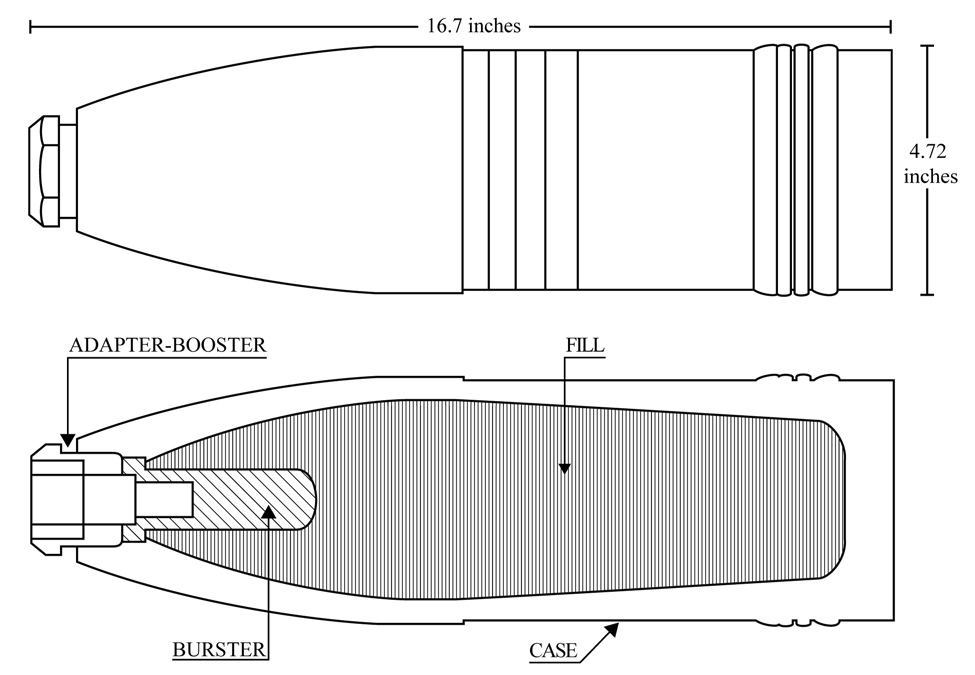
The body of the 4.7-inch gas round was identical to the point fuzed common steel round (MK I), except that it had no base cover, and the tap hole to receive the adapter was tapered to make a gas tight joint. This round had an ogival head, fitted with a copper rotating band forced into an annular groove 1.9 inches from the base. About 0.5 and 1 inch, respectively, below the rotating band, two circumferential grooves were cut to receive the crimping of the cartridge case. When assembling, the round was forced into the case up to the band, and the metal case was set into the grooves at several points, securely fixing it. Sufficient space was left for expansion when the gas regained atmospheric temperature. The installation of an adapter sealed the gas hermetically in the body. A booster charge was located in the adapter, which was sufficient to open the nose and release the gas.
Any of the fuzes used with the common steel round fit the gas round; however, three fuzes were normally used with this round, which was tapped through the nose to receive the adapter for one United States and two French type fuzes. These fuzes are: the U.S. Mk III; the French I.A.L., Model 1916; and French I.A., Model 1915. The three fuzes varied in weight 0.6 to 1.2 pounds. The shell was never issued fuzed.
Functioning
No information about functioning.
Hazardous Components
No information about hazardous components.
See Also
Nothing else to see.
Source(s)
Old Chemical Weapons and Related Materiel Reference Guide (2018)
Old Chemical Weapons Reference Guide (1998)
