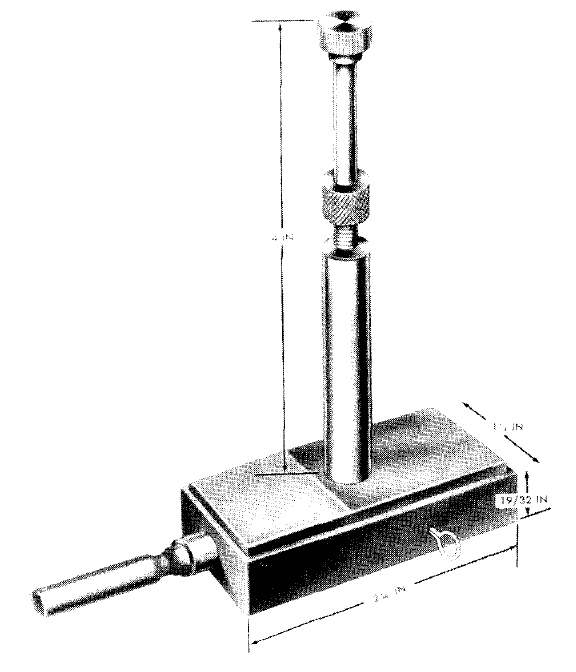
Description
The Soviets used this fuze primarily with improvised railroad mines. The rod is adjusted under the rail until the top of the rod is flush with the bottom of the rail. The fuze was also used with improvised mines under bridges. Sometimes the fuze was installed with the detonator directly inserted into the charge; at other times, detonating cord was inserted between the detonator and charge, the length depending upon the desired distance between the charge and fuze.
This fuze is an instantaneous, mechanical, pressure type containing a spring-loaded striker with a trigger release. It consists of a rectangular metal case with a hinged lid. A two-section metal rod is screwed into the middle of the lid. The top half of the pressure rod screws into the bottom half for height adjustment. The body of the fuze contains a metal striker-release trigger in a housing. The trigger rests on two springs at one end of the box. The bottom of the trigger engages in a recess in the end of the striker and holds the striker and its spring under compression. The other end of the fuze is recessed and threaded to receive an MD-2 detonator assembly. A safety pin prevents the trigger from moving.
Functioning
Pressure of 25 to 40 pounds on the pressure rod depresses the hinged lid which, in turn, presses on the trigger, compressing the springs until the bottom of the trigger is pushed out of the recess in the end of the striker. This releases the spring-loaded striker against the percussion cap.
Hazardous Components
No information about hazardous components.
Physical Data
No additional physical data available.
See Also
Nothing else to see.
Source(s)
