Description
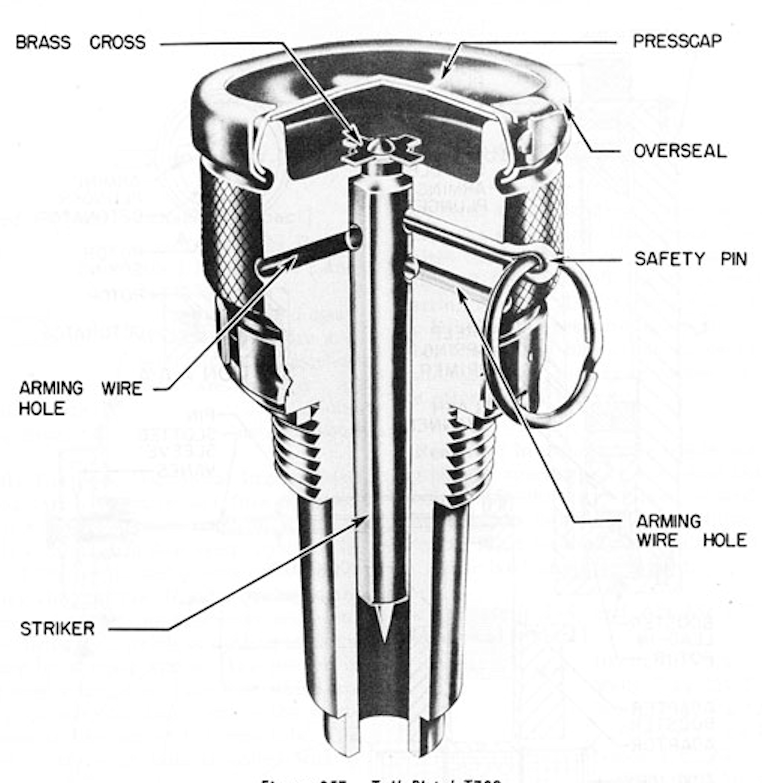
This pistol is a simple impact mechanism consisting of a brass body with a central channel to accommodate a heavy striker. The striker is retained by a small brass cross which is fastened to the top of the striker by A copper pin. In the normal condition, the four tabs of the brass cross extend outward over the top of the pistol body, preventing the striker from descending. Two arming-wire holes are drilled in separate planes at 90° to each other. The hole to be used is that which gives the more favorable angle of pull-off for the arming wire from the pistol to the fuzing unit. Parallel to one of these aiming wire holes, and about 1/4 inch above it, is located a safety-pin hole.
The use of this pistol is restricted to high-level bombing operations, as there is danger of non-functioning from low altitudes.
Three of these pistols, located 120° apart in the base plate, are used with the 12,000-pound GP bomb.
The striker used with this pistol is of the needle type; thus only sensitive-type detonators can he used.
Functioning
When the bomb is released from the aircraft, the arming wire is withdrawn from the pistol, leaving the striker supported only by the brass cross. On impact, the inertia of the striker bends the tabs of the brass cross, allowing the striker to move forward and pierce the detonator.
Hazardous Components
No information about hazardous components.
See Also
Nothing else to see.
Source(s)
OP 1664, Volume 2 - US Explosive Ordnance (1947)
