Description
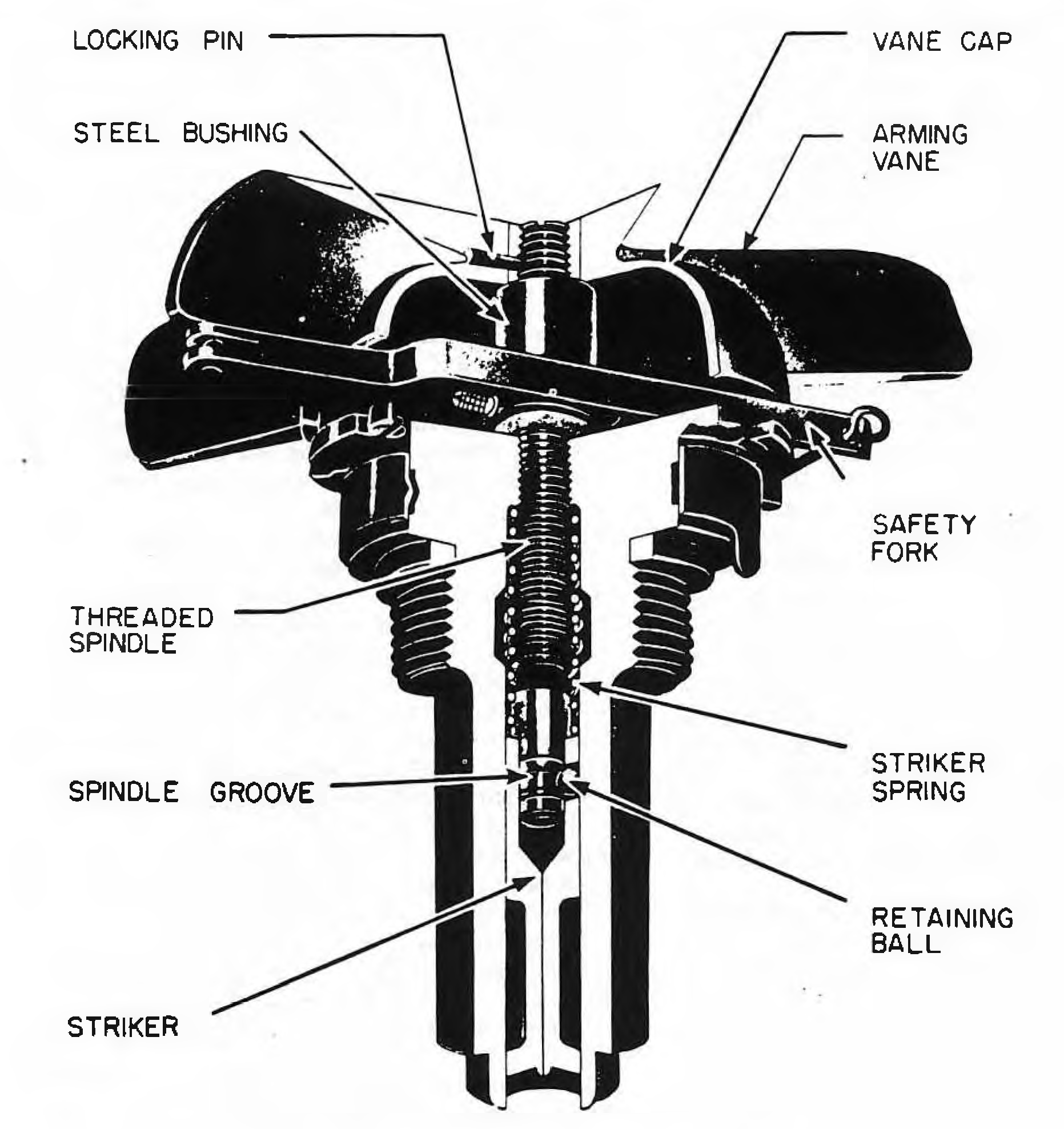
This pistol is externally similar to the Pistol No. 27, but is altered internally to permit aerial-burst functioning. The top of the pistol body is internally threaded to receive a threaded spindle. Over the top of this spindle are screwed the vanes and vane cap, the latter being firmly secured to the spindle by a pin. Fitting loosely around the spindle, immediately above the fuze body, is located a steel bushing. Around the lower part of the spindle is cut an annular groove, which is engaged by two small retaining balls located in holes in the striker. The spindle in the unarmed condition is thus firmly locked in engagement with the striker, the balls being prevented from moving out of engagement by the inner wall of the pistol body. About two-thirds of the way up, the central hole in the pistol body is enlarged sufficiently to allow the retaining balls to move outward and disengage the striker from the threaded spindle.
Opposite sides of the vane cap are cut away to receive the brass safety fork, to which a steel clip spring is attached. The latter fits around the bushing and holds the safety fork in place. Eight slots are cut in the outer perimeter of the top of the pistol body, and the locking stud of the safety fork fits into one of these slots. A safety pin passes through the arms of the safety fork. A tab locking device is located around the pistol body below the slotted flange.
The pistol incorporates a blunt striker, and therefore is used only with anvil type detonators. The Pistol No. 36 Mk I is an earlier model of the No. 36 Mk II and is a conversion of stocks of Pistols No. 27. The Mk I differs from the Mk II only in that the former incorporates a threaded bush to form the enlarged recess in the pistol body, while the body of the latter is machined from a single piece of brass.
Functioning
No information about functioning.
See Also
Nothing else to see.
Source(s)
OP 1665, British Explosive Ordnance (1946)
