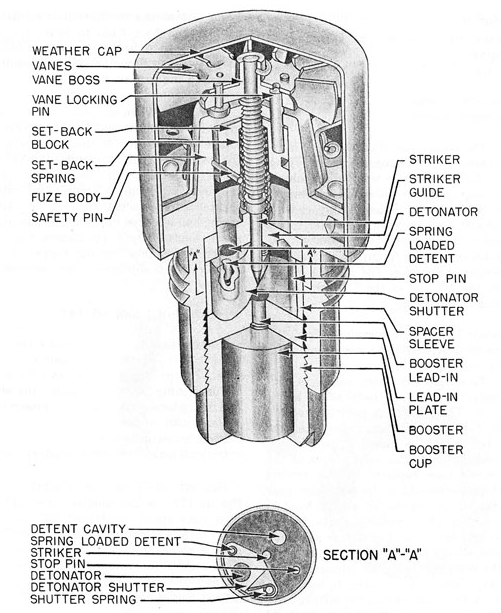
Description
The Nose Fuze Mk 148 is similar to the Mk 137, but has smaller vanes, and, instead of a vane guard, is shipped with a protective cap which is removed when the rocket is loaded on the plane. It fires at impact angles as low as 5° and 10° for water or land targets, allowing slight penetration. On hard targets, it fires at impact angles not less than 20° to 25°.
Functioning
The weather cap is removed when the rocket is loaded on the launcher. After the rocket is loaded on the launcher, the safety wire is withdrawn and the arming wire is installed through the arming-wire guide. Two Fahnestock clips secure the arming wire. When the propellant is ignited, the forward motion of the rocket pulls the arming wire free and the force of inertia causes the set-back block to set back against the set-back spring. Since the vane locking pin is positively attached to the set-back block, it is thus withdrawn to a position flash with or below the top of the fuze body. This frees the vanes to rotate, unscrewing the striker as they rotate. The vanes must make from three to four rotations during- acceleration to unscrew the striker sufficiently to prevent re-engagement of the vane locking pin as the set-back spring gradually forces the set-back block and locking* pin up. After eight or nine rotations of the vanes, the striker will have unthreaded sufficiently to free the spring-loaded detonator shutter. The latter is then rotated by the shutter spring into the armed position, where it is stopped by the stop pin, lining the detonator up with the striker and booster lead-in. As the shutter reaches the armed position, ft spring-loaded detent carried in the shutter is forced into a recess in the striker guide, locking the shutter in the armed position. After an additional rotation or two, the end of the threads on the striker spindle is reached, and the vanes rotate freely as the Collar at the end of the threads rides in a groove in the fuze body. On impact, the striker is forced in, shearing the threads in the nose of the fuse body, and is driven into the lead azide detonator.
Hazardous Components
No information about hazardous components.
See Also
Source(s)
OP 1664, Volume 1 - US Explosive Ordnance (1947)
