Description
The fuze consists of a nose cap with two water ports which is screwed on the upper fuze housing.
The fuze will function under water on angles of impact up to 75°.
Mods 1 and 2 of this fuze are similar to the Mk 135 Mod 0 in general design, except that the sensitivity has been about doubled, and the static pressure to arm has been increased to a head of approximately 50 feet. The fuzes, when fired from launchers, arm at a depth of 20 feet. The Mod 2 differs from the Mod I in that detents lock the bell cranks in the armed position and the safety pin arrangement in the nose has been slightly altered.
Functioning
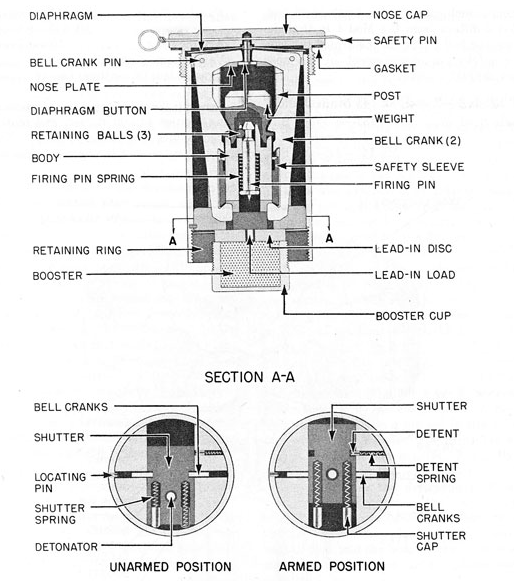
A phosphor-bronze diaphragm is housed in the upper end of the fuze. This diaphragm works against the diaphragm button and two bell cranks. The bell cranks are pivoted on pins fixed to the halves of the nose plate. In the unarmed position, the cranks engage the shutter and also keep the body and weight locked together. In this position the firing pin is locked, with spring compressed, by three balls. A freely moving safety sleeve, on set-back, engages hooks in the bell cranks and prevents air pressure from arming the fuze. On deceleration in the water, this safety sleeve engages the bell cranks to reduce the possibility of premature functioning.
A retaining ring screwed into the lower fuze housing secures the booster magazine and booster lead-in disc in the fuze. A gasket is located on the under surface of the shoulder of the nose cap to provide a watertight seat in the rocket. A safety pin is inserted through the nose cap and diaphragm button nut, thereby locking the diaphragm in the unarmed position.
When the fuze enters the water, pressure of the water which enters the water ports in the nose cap acts on the diaphragm. When the projectile has reached a depth of 15 to 20 feet, the diaphragm is inverted. This diaphragm action moves the two bell cranks out of engagement with the shutter, which is forced by its spring into position under the striker. The shutter is locked in this position by a detent housed in the body. At the same time the bell cranks also move out of engagement with the body and the weight. The fuze is then fully armed.
If the fuze should arm prematurely, before the charge has slowed down sufficiently, the weight will be pulled off by its own inertia when the bell cranks move outward, allowing the firing pin to function before the shutter will have moved into place. The result will be a dud.
The fuze is designed to function upon impact with a solid object but not on impact with soft objects such as muddy or sandy bottoms. Upon solid impact, the sudden deceleration pulls the weight forward, forcing the three balls inward. This frees the weight, allowing it to fall out of its engagement with the body. The three balls are then ejected by the force of the firing pin working against its compressed firing-pin spring. The firing pin is now free to be forced by its spring against the detonator, thus actuating the fuze. A glancing blow causes the weight to pivot about a point on the edge, where it is supported against the body and releases the three balls. The sensitivity to forward and sidewise impact is about equal.
Hazardous Components
No information about hazardous components.
See Also
Nothing else to see.
Source(s)
OP 1664, Volume 1 - US Explosive Ordnance (1947)
