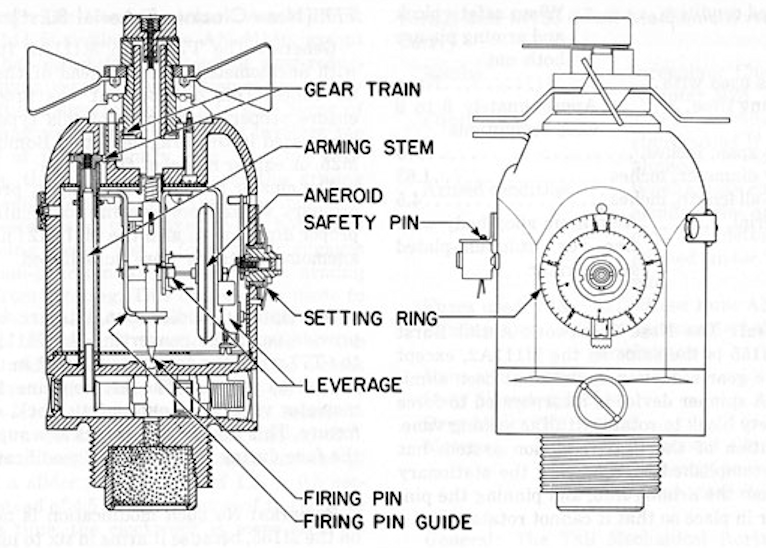
Description
This is an experimental design to obtain accurate firing at preset barometric pressure levels, and thus facilitate firing at exact altitudes (possibly within 200 feet of the setting). The fuze was originally designed for flares, but may lie employed for other tactical purposes as testing continues.
Being air-travel armed, the T27E4 has vanes and gears similar to the M111 type of fuze. However, the gears act to thread an arming stem in the side of the fuze upward, allowing the spring-loaded detonator slider to be moved out and in line with the firing pin. A key screw in the fuze base rides in a slot in the side of the detonator slider and prevents rotation or misalignment of the detonator slider.
Functioning
The safety pin on the outside of the fuze body locks the trip-firing mechanism. This pin is removed by the arming wire as the bomb is released. When this safety pin is removed, the aneroid bellows is free to move (through its leverage system) the trip-firing mechanism when the fuze reaches an area of pressure corresponding to that set on the dial.
Hazardous Components
No information about hazardous components.
See Also
Nose, MT, M111, M111A1, M111A2
Source(s)
OP 1664, Volume 2 - US Explosive Ordnance (1947)
