Description
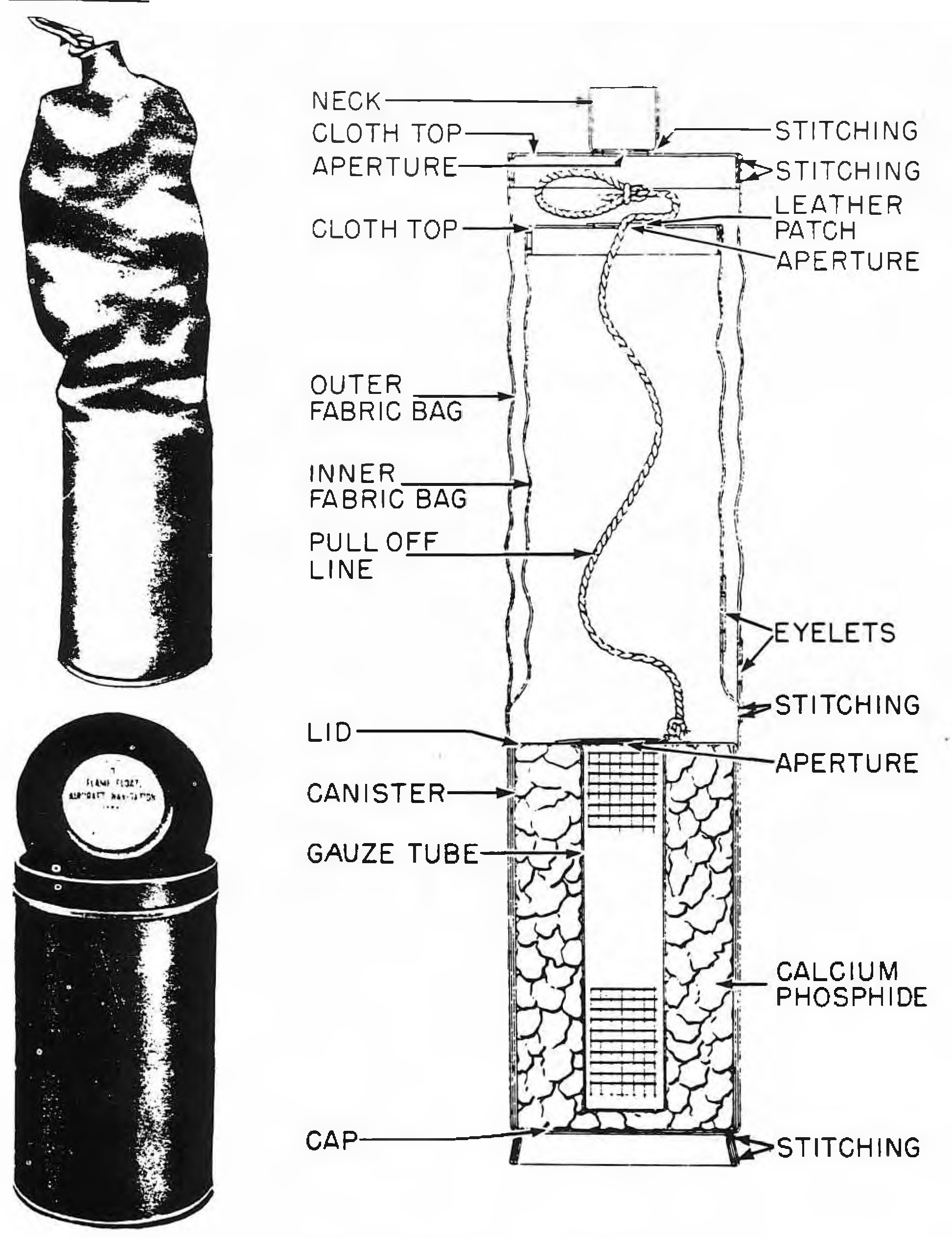
The float consists of a cylindrical tin-plate canister with a tin-plate lid, having a central aperture, soldered over the top of the canister, and a slotted brass sealing patch soldered over the aperture. Soldered to the lid is an iron gauze tube, which extends axially nearly to the bottom of the canister, and is closed at its lower end. The annuallar space outside the gauze tube is filled with granular calcium phosphide. At its base the canister is closed by a cap, which fits over its outside. The canister is surrounded by an outer fabric bag, which is considerably longer than the canister. Secured by a double row of stitching inside the outer fabric bag and above the canister, is a second fabric bag, termed the inner fabric bag. Two eyelets are located above the top of the canister in the walls of the inner and outer fabric bags at different levels. The pull-off line passes through the aperture in the leather patch at the top of the inner fabric bag and through the neck of the outer fabric bag. The aperture has a fairly snug fit on the line.
The flare may be dropped from any height and gives a reasonably steady and bright flame for about five minutes. A flame continues for an additional 15 minutes, but it becomes increasingly feeble and intermittent. If the sealing patch of the canister has been removed, the flame float must be dropped or removed to a safe place for disposal
Functioning
No information about functioning.
See Also
Nothing else to see.
Source(s)
OP 1665, British Explosive Ordnance (1946)
