Description
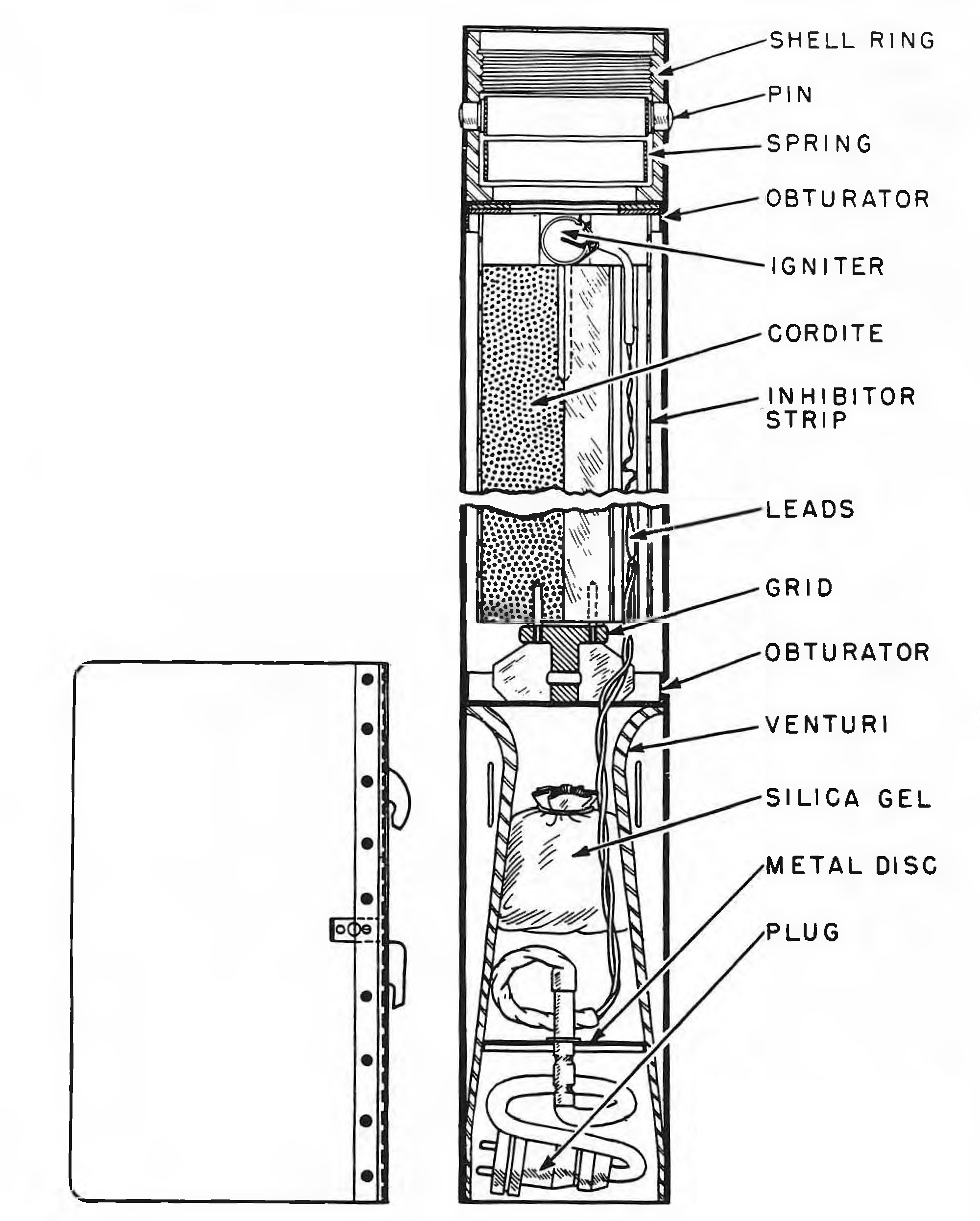
This motor consists of a long steel cylinder with a shell ring at the forward end held in place by eight locking pins, which are held in engagement by two circular band springs. A thin metal-headed obturator is located beneath the shell ring and is separated by cardboard washers from the forward end of the propellant grain. The head of the grain is castellated to accommodate the Igniter, Fuze, Electric, No. 53*. The base of the propellant grain is supported by a metal grid, which in turn rests against the tail obturator. The steel venturi tube is welded to the inside of the motor just behind the tail obturator and contains a bag of silica gel as a moisture-proofing measure.
The igniter leads extend from the igniter through the central annulus of the tubular cordite grain, along the outside groove of the cruciform grain in the Motors No. 1 Mks II and III, through the tail obturator and venturi, and through the metal closing plate, and terminates in a two-pronged plug. This plug connects with a socket extension on the rail launcher, when the rocket is loaded aboard the plane.
Eight slots are located in the motor body near the after end for attachment of the four fins.
The rockets are suspended by two saddles, each carrying a T-lug, which rides in the grooves of the launcher rails.
Motor, Rocket, A/C, 3-in. No. 1 Mk II - This motor differs from the No. 1 Mk I in that the propellant grain is cruciform in shape rather than tubular. The igniter leads are brought along the outside grooves of the grain, rather than through a central annulus, and a different type grid is employed. Proposed new nomenclature for the Motor No. 1 Mk II is: Motor, Rocket, A/C, 3 inch, No. 5 Mk I.
Motor, Rocket, A/C, 3-in., No. 1 Mk III - The main difference between the Motors Mk II and Mk III is that the Mk III has a weak link pigtail as against a niphon plug in the Mk II motor. The proposed new nomenclature for this motor is Motor, Rocket, A/C, 3-in., No. 5 Mk II.
Motor, Rocket, A/C, 3-in., No. 1 Mk IV - This motor differs from the No. 1 Mk III in that a small metal clip is loosely inserted over the igniter leads between the niphon plug and the attachment to the metal closing disc. The Motor Mk IV also has a longer pigtail lead; this greater length of lead being required for the lower round when using the “tier carriage” scheme. The proposed new nomenclature for this motor is Motor, Rocket, A/C, 3-in., No. 5 Mk III.
These motors are colored either green or white overall, with identification stencilings in yellow.
Functioning
No information about functioning.
See Also
Source(s)
OP 1665, British Explosive Ordnance (1946)
