Description
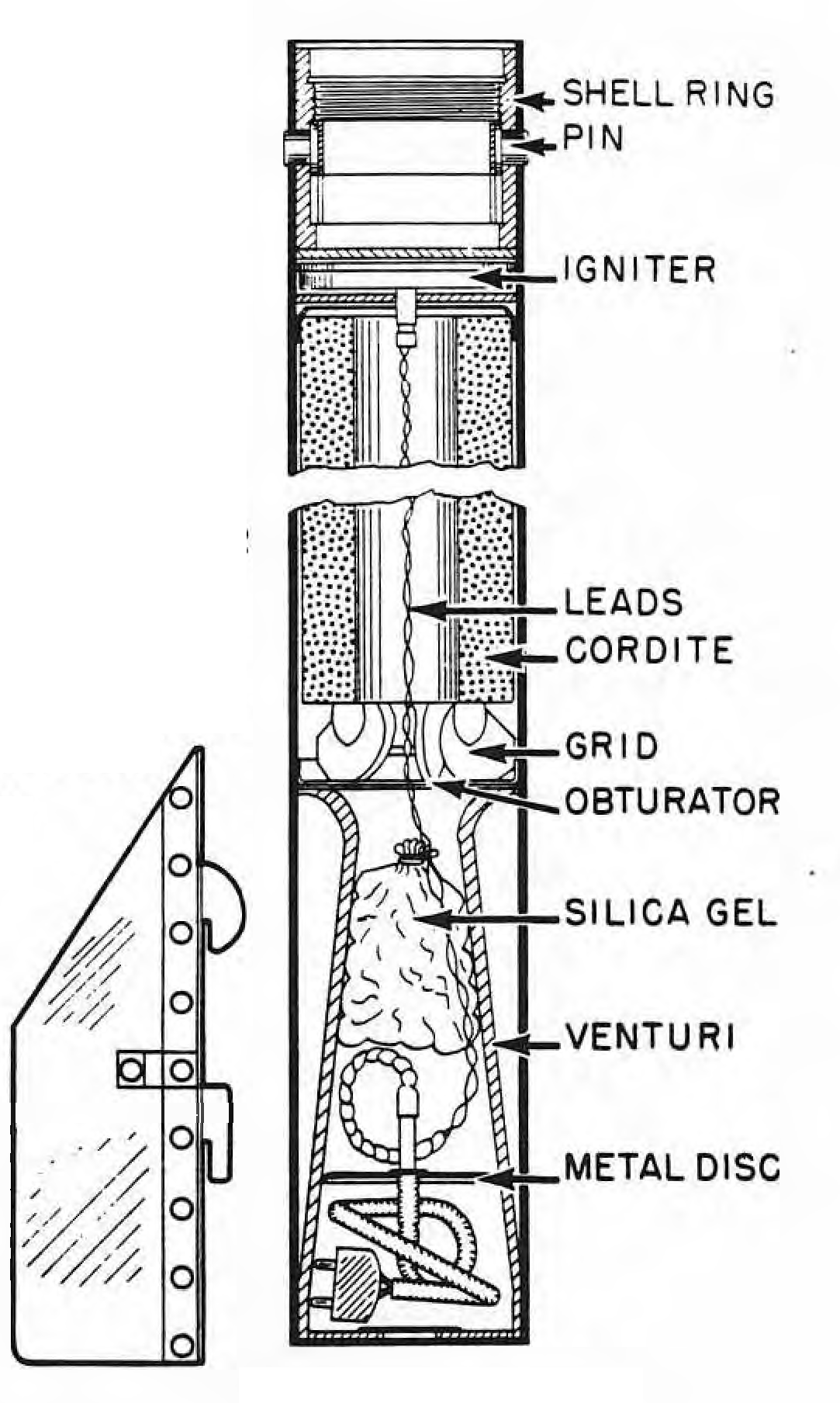
The motor consists of a steel tube fitted with a shell ring at one end and at the other with a venturi tube. The threaded shell ring is held in position by eight locking pins engaged by a circular band spring.
The venturi is welded to the inside of the motor body. A steel grid, separated from the venturi tube by the tail obturator, supports the cog-shaped cordite propellant grain. A metal closing disc in the venturi tube supports the igniter leads, which terminate in a two-pronged plug. The after end of the venturi is sealed by a cardboard closing disc. The igniter leads extend from the plug through the central annulus of the propellant grain to the metal igniter housing, which contains a small electric squib surrounded by a charge of gunpowder. Behind the metal closing disc in the venturi is located a bag of silica gel as a moisture-proofing measure.
The four fins are assembled to the motor by engaging their hooks in the fin slots in the after end of the motor body and pressing home the locking catches on the fins. A 10-yard extension cable is provided with each motor for firing purposes, thus allowing personnel to take cover when firing occurs. The extension is plugged at one end and contains a two-hole socket at the other for attachment to the plug connected to the igniter leads of the motor.
Functioning
No information about functioning.
See Also
Source(s)
OP 1665, British Explosive Ordnance (1946)
