Description
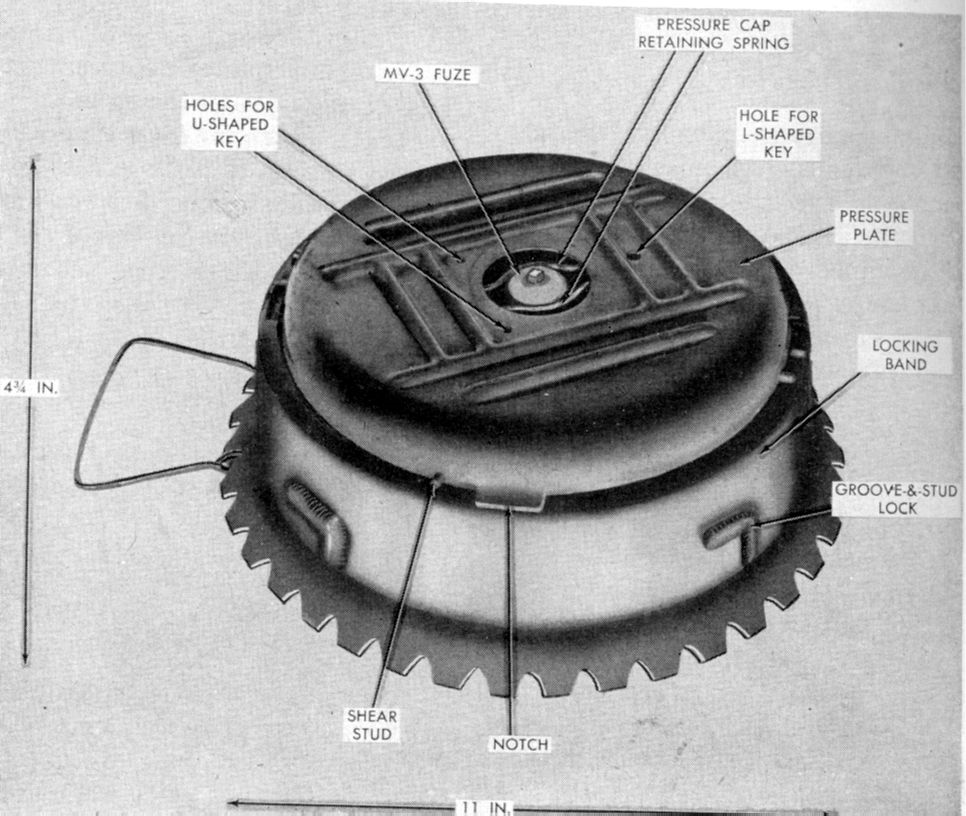
The PMZ-40 obstacle mine is a dual-purpose mine made of pressed steel and is 11 inches in diameter. It is 4 3/4 inches high when set for antitank use and 4 inches high when set for antipersonnel use. It weighs 20 pounds, including about 8 pounds of explosive. The mine consists of three parts: the charge container with a flanged base, a central fuze well, and a charge filling hole in the bottom closed by a steel plug; a pressed-steel band, held to the charge container by four lug and groove locks, and flanged on the top; a pressure plate, grooved to add rigidity, with four shear studs equally spaced about its edge. When resting on top of the rim these studs make the mine antitank; when turned to drop into the four notches in the rim, they make the mine antipersonnel. The pressure cap closes the central fuze well. It is held in place by a retaining spring under the pressure plate. The MV-3 fuze was specially designed for this mine. It is a round ball release type fuze, has no safety, and has a percussion cap, detonator, and metal-cased booster charge screwed to the base. This mine was issued in Korea with the MV-5 instead of the MV-3 fuze.
Set for antitank use, the PMZ-40 obstacle mine is used in road blocks. When laying an antitank mine field, a number of these mines can be set for antipersonnel use, which will harass mine clearing and breaching parties.
Functioning
When set for antitank use - Pressure of about 500 pounds shears the four shear studs on the side of the pressure plate, depressing the fuze and detonating the mine.
When set for antipersonnel use - The pressure plate is rotated so the shear studs drop into the corresponding notches in the rim of the band. Therefore, there is no shearing action and pressure is transmitted directly to the head of the fuze.
Hazardous Components
Main charge - 8 lbs. (3.64 kg)
Physical Data
Diameter - 11 in. (279 mm)
Height - 4.75 in. (121 mm)
See Also
Source(s)
Afghanistan Ordnance ID Guide, Volume 1 (2004)
TM 5-280, Foreign Mine Warfare Equipment (1963)
TM 5-223A, Soviet Mine Warfare Equipment (1951)
