Description
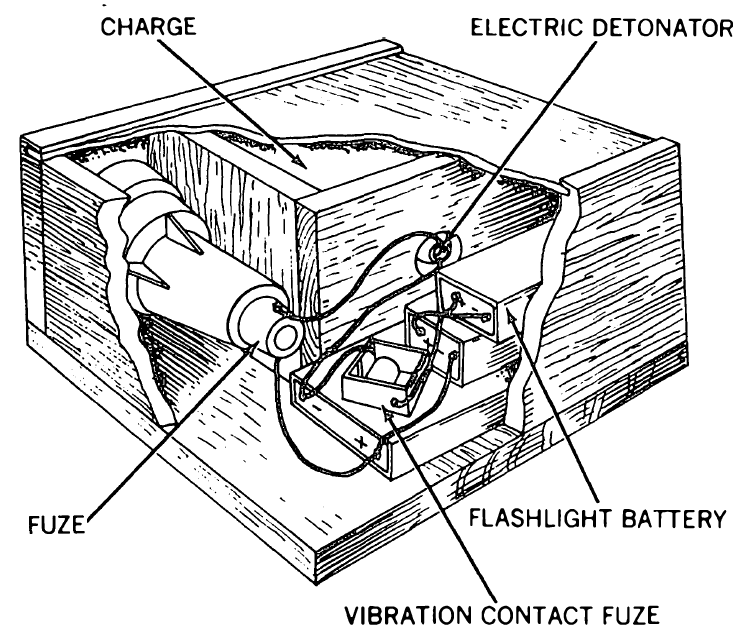
This mine is a wooden box which has two compartments. About 1.75 pounds of explosive is in one compartment and an electrical detonating circuit in the other. The detonating circuit consists of an EKhV fuze, three batteries, a vibration contact fuze, and an electric detonator. It is 8 1/2 inches long, 8 1/2 inches wide, and 4 1/2 inches high. The mine has a sliding lid. It is waterproofed with tar, and the batteries and the vibration contact fuze are imbedded in paraffin. The EKhV fuze is fitted with an electric-contact base instead of the MD-2 detonator assembly as in the MZD-1 mine. The EKhV fuze is inserted in the detonating circuit to provide a delay period before the mine is armed.
This mine was used primarily to detonate large charges in railroad beds. It is normally buried 2 to 3 feet underground, but only 15 to 20 inches in freezing weather.
Functioning
The EKhV fuze is connected into the detonating circuit and, after the fuze functions, the circuit is closed except for the vibration contact fuze. Any subsequent vibration or movement of the mine causes the vibration contact fuze to close the circuit, firing the electric detonator.
Hazardous Components
Main charge - 1.75 lbs. (0.8 kg)
Physical Data
Length - 8.5 in. (216 mm)
Width - 8.5 in. (216 mm)
Height - 4.5 in. (114 mm)
See Also
Landmine, Delayed Action, MZD-1
Source(s)
