Description
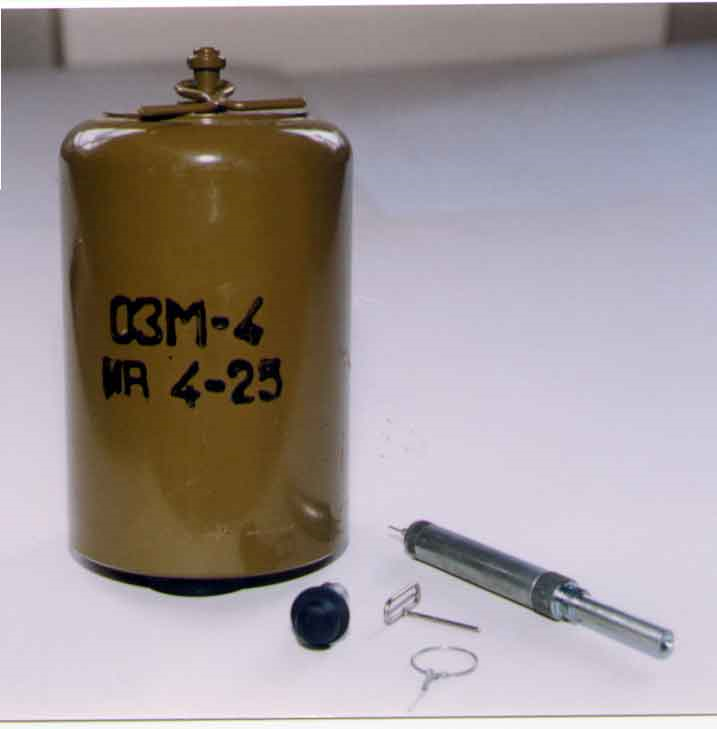
The cylindrical OZM-4 bounding antipersonnel mine is the successor to the OZM-3. The OZM-4 is larger than the OZM-3 and does not have a secondary electrical fuze well as does the OZM-3. The mine consist of a cast-iron body, which is propelled into the air by the detonation of a small charge in the base of the mine. Detonation is normally accomplished from a tripwire fuze, but command-detonated (electrical), tension-release, or simple pressure fuzes could also be used. The height of explosion is determined by a lanyard attached to a base plate, which remains in the ground. This anchor wire functions the main explosive charge 0.6 to 0.8 meter above the ground. The ensuing fragmentation of the mine body results in a lethal radius of 15 meters.
The mine does have a fuze well but does not use a power source.
The mine case is OD green.
Functioning
No information about functioning.
Hazardous Components
No information about hazardous components.
See Also
Source(s)
Afghanistan Ordnance ID Guide, Volume 1 (2004)
Iraq Ordnance Identification Guide (2004)
