Description
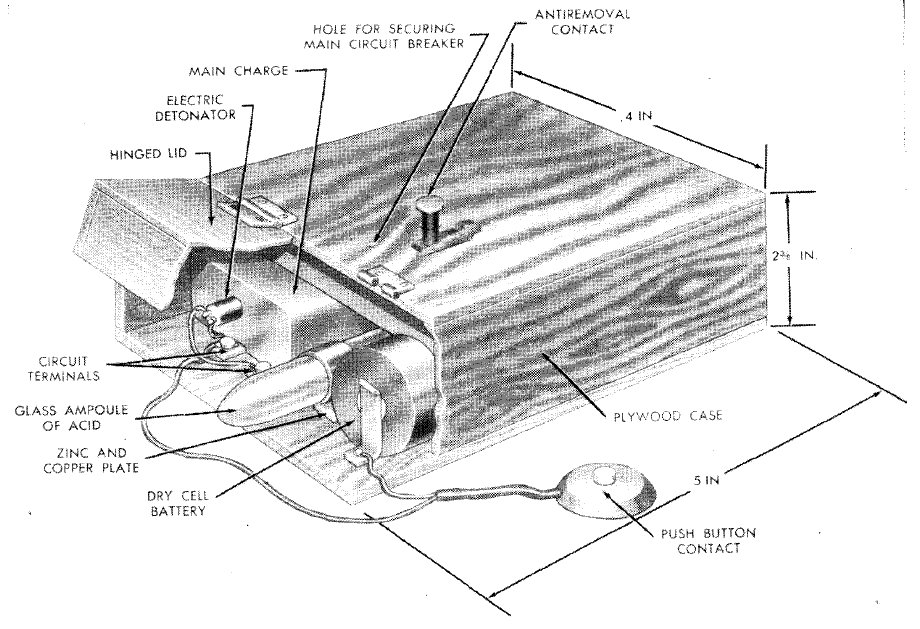
This mine is contained in a plywood box 5 inches long, 4 inches wide, and 2 3/8 inches high. This box contains 0.5 pound of explosive and an electrical circuit, consisting of a dry-cell battery, two electrical contacts, and a chemical contact. One end of the box and part of the lid are hinged to the remainder of the lid which is fixed. The hinged lid is employed as a pressure piece. It rests on the pointed end of the glass ampoule of acid which acts as the chemical ignition device. The ampoule rests on a copper and a zinc strip wired into the circuit. To the rear of the ampoule is the main circuit breaker which is held open, while the mine is being laid, by a wire leading out through a hole in the fixed lid. Attached to the under side of the fixed lid is a spring-loaded anti removal contact with the contact post projecting through the lid and held down (open), when the mine is laid, by a rock or other weight. A push-button contact is also wired into the circuit. The circuit diagram for this mine is shown.
Because of its low explosive content, this mine is intended primarily for antipersonnel use.
Functioning
(1) Pressure on the push-button contact completes the circuit and fires the mine, or
(2) Pressure on the hinged lid crushes the glass ampoule of acid which, when it seeps onto the copper and zinc plate, creates an electrical impulse, completes the circuit, and fires the mine, or
(3) Releasing the rock or weight resting on the lid on the anti removal contact permits the spring-loaded contact post to rise until it closes the contact, completing the circuit and detonating the mine.
Hazardous Components
Main charge - 0.5 lbs (0.23 kg)
Physical Data
Length - 5 in. (127 mm)
Width - 4 in (102 mm)
Height - 2.38 in. (60 mm)
See Also
Nothing else to see.
Source(s)
