|
British Grenade, Rifle, Illumination, No. 57, No. 58, No. 59, No. 60, No. 61, No. 62 |
Scroll Prev Top Next More |
Description
The construction of this entire series of grenades is generally similar to that of the 2.5-in. Illuminating Rifle Grenade No. 57 Mk I, whose description follows.
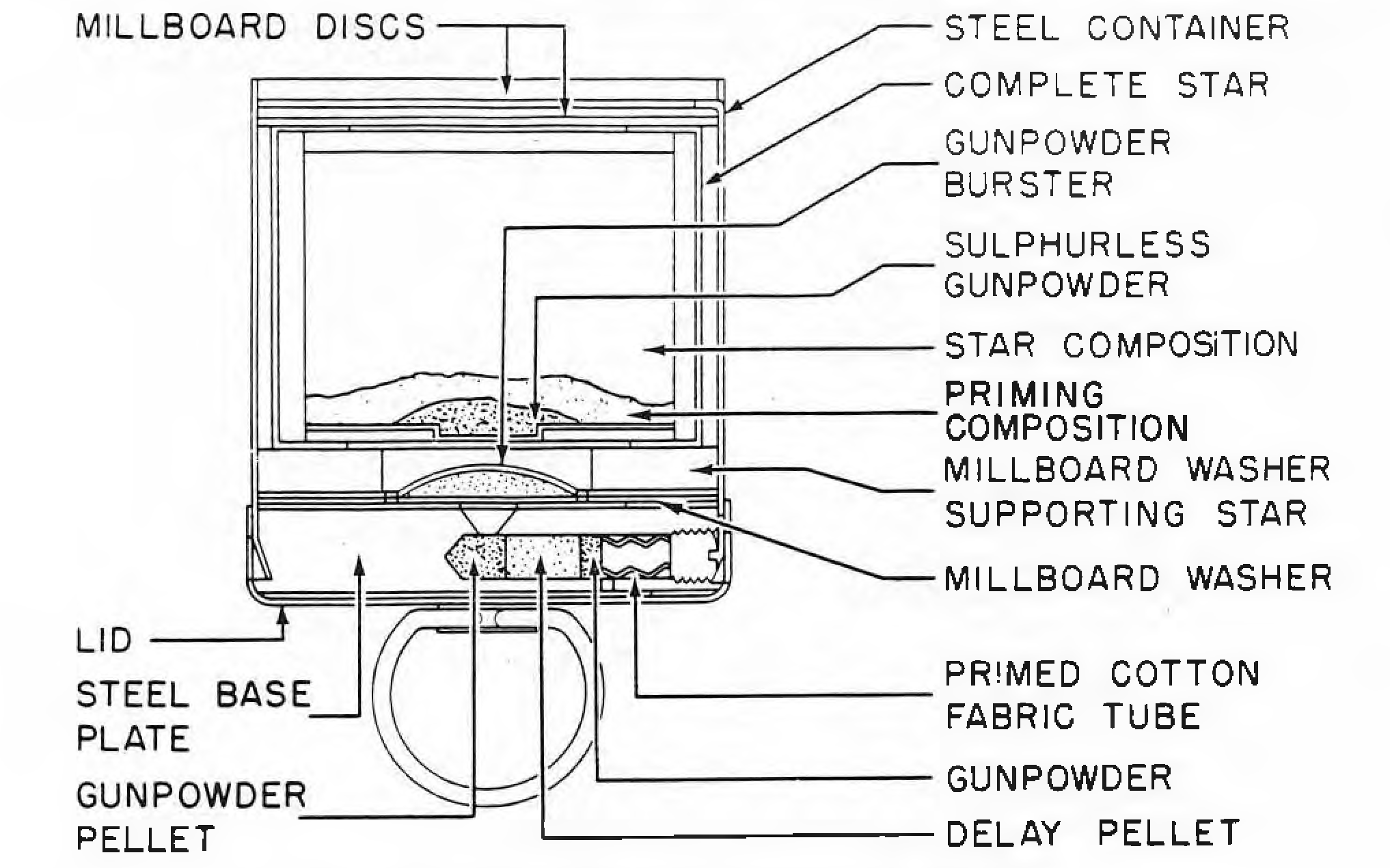
The body of the grenade consists of a cylindrical steel case, whose base is closed by a steel base plate. The top of the body is closed by several millboard discs. A friction-fit steel lid, with a ring for easy removal, fits over the base to protect the ignition system.
The base plate of the grenade has a drilled radial hole, which contains the ignition system.
A small hole connected to its outer end allows the flash of the cartridge to contact the ignition system, while a coned hole at its inner end leads to the gunpowder burster in the interior of the grenade. The ignition system, which is retained in the radial hole by a screwed plug, consists of a tube of primed cotton cambric, a layer of gunpowder, a delay pellet, and another small charge of gunpowder, which relays the flash to the gunpowder burster of the grenade. The paper-wrapped star rests on a millboard disc, which separates it from the gunpowder burster. The star composition is ignited by a layer of priming composition, in turn ignited by a small charge of sulphurless gunpowder; all of which are integral components of the star.
These grenades are used in the 2 1/2 inch discharger cup and fired by means of the 0.303 in. H. Rifle Grenade Cartridge Mk IZ. The 2 inch mortar signal and illuminating bombs have largely replaced this series.
Functioning
No information about functioning.
See Also
Nothing else to see.
Source(s)
OP 1665, British Explosive Ordnance (1946)
