Description
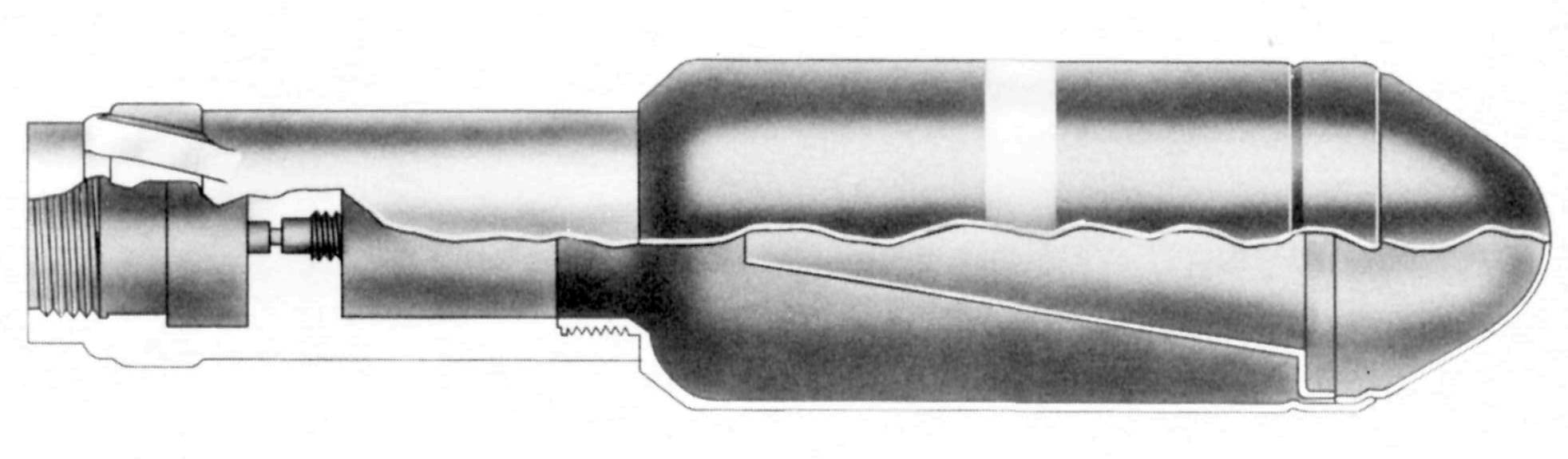
This grenade is a copy of the German Gross Gewehr Panzergranate and is fired from a cup launcher attached to the standard 6.5 mm rifle.
The body is cylindrical with a semi conical shaped head. It is made in two parts threaded together and fitted with a ballistic cap to give the hollow-charge effect. The forward part contains the explosive charge cast around the cone. The after part which is made of aluminum has a rifled collar near the base and contains the fuze and explosive train.
The fuze is held in by a base plate with a protruding spigot which is screwed into the base of the grenade. The fuze is held in position by the spigot. The needle firing pin is secured in a housing that has four stirrup-like springs protruding from the side. Around the housing is a setback spring held in by an arming sleeve which has two sets of grooves notched on the inner side. Holding the firing pin stationary is a coil clock spring which is held in by the arming sleeve. There is also a creep spring between the firing pin and detonator. The propelling charge consists of a special cartridge with a wooden bullet.
Functioning
On firing, setback causes the arming sleeve to move down and it is held down by the stirrup springs which engage in the groove in the arming sleeve. Centrifugal force then causes the clock spring to expand and the fuze is armed. On impact the firing pin housing overcomes the creep spring and moves onto the flash cap setting off the detonator and booster.
Hazardous Components
Filler - 50/50 RDX and TNT, 3.81 oz (107 grams)
Physical Data
Diameter - 1.58 in (40 mm)
Length - 7.98 in (203 mm)
Weight -12.45 oz (349 grams)
See Also
Grenade, Rifle, 30mm Hollow Charge
Source(s)
OP 1667, Japanese Explosive Ordnance, Volume 1 (1946)
