Description
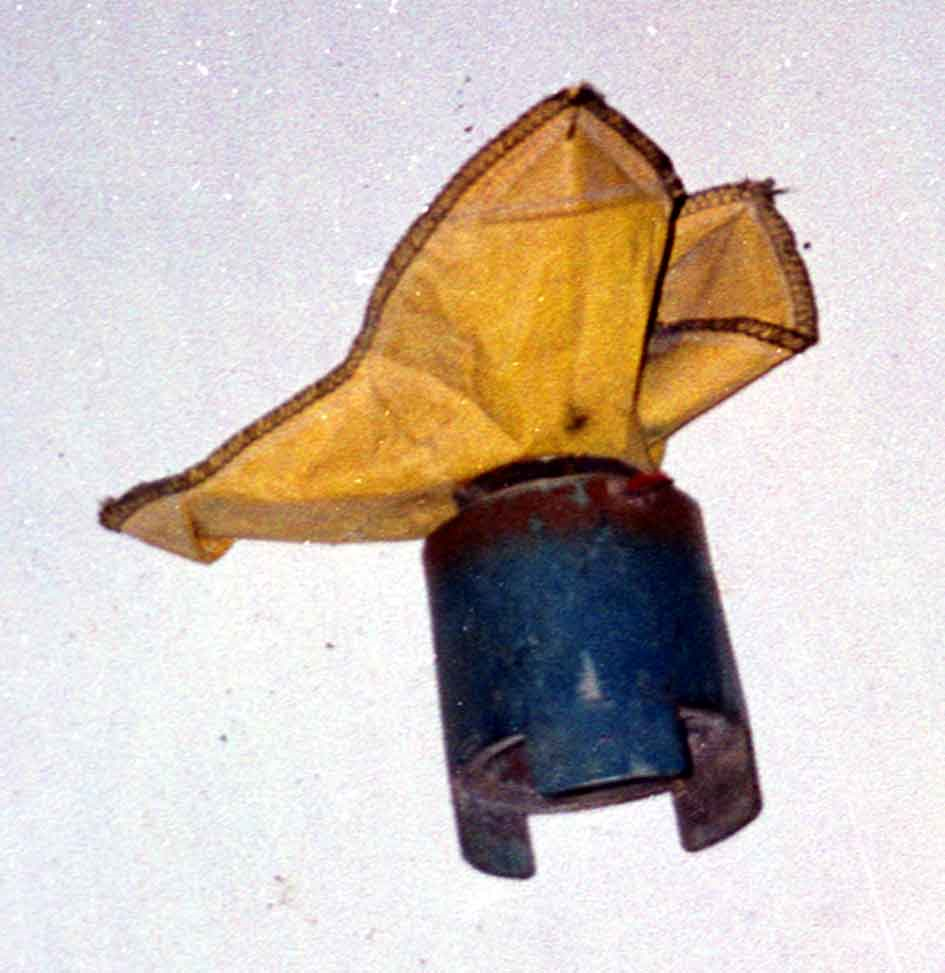
These are small aerial-dispensed, decelerator-stabilized and decelerator-armed, impact-fired grenades. The M75 is a practice grenade containing a live fuze with a flash/smoke charge. The grenade consists of three major components: RAD, the fuze, and the grenade body.
The M230 and M231 fuzes are very similar in appearance and operation. Approximately 20.00 pounds (9.07 kilograms) of pull is required on the arming pin at RAD deployment to release the detonator slider. The M230 fuze has the booster attached to its base; while the M231 does not have a booster, it permits the detonator to flash down and ignite the flash/smoke charge. The M75 grenade body contains a cone with a flash/smoke charge.
The RAD is made from Kelvar material and contains three air scoops around its periphery. The fuze is installed in the top of the grenade body and interfaces with the base of the RAD. When the fuze is armed, the end of the slider extends out of the edge of the fuze housing. The M231 fuze (used in the M75 grenade) contains one hole on top of the fuze. The grenade body contains three standoff legs.
The M75 practice grenade (carried in the M267 practice warhead) differs in fuzing, color, and markings. The M75 grenade is dark blue with a brown band. The RAD for each grenade is yellow. The simulators are painted blue with no markings or color bands.
Functioning
No information about functioning.
Hazardous Components
No information about hazardous components.
See Also
Rocket Warhead, 2.75 inch Practice, M267
Source(s)
TM 43-0001-30, Rockets (chg 14, 2001)
