Description
The flare provides a target for both day and night practice firing of antiaircraft guns.
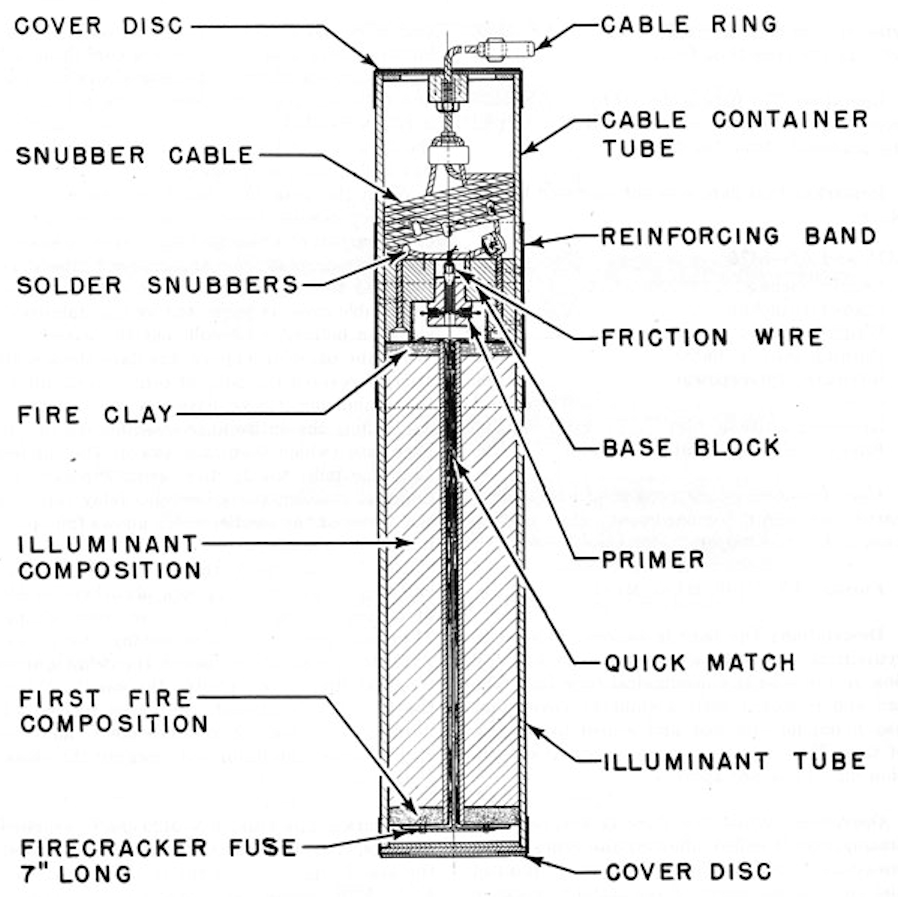
The flare consists of an illuminant tube and a cable-container tube made of rocket paper. These are joined end-to-end under the external metal reinforcing band. Both ends are closed by chip-board discs held in place with tape. The cable ring is attached to the snubber cable at the end which protrudes through the cover disc of the flare assembly. The snubber cable is attached to the base block with staples.
Friction wire is attached to the end of the snubber cable and extends through the primer composition, which is adjacent to the quick match which runs through a cardboard tube in the center of the illuminant. At the end of the quick-match tube is a firecracker fuse terminating in the first fire composition, which is in contact with the main illuminant charge.
The flare may be streamed from any plane from which an aircraft or antiaircraft target reel can be mounted.
Functioning
The flare slides back along the tow cable until the cable ring is stopped by the target release mechanism. Force exerted on the snubber cable pulls off the end of the cable- container tube, and the five solder snubbers are stripped off. The staples holding the snubber block to the base block arc withdrawn by the pull exerted. Friction wire attached to the end of the snubber block is pulled through the primer. The flame from the primer ignites the quick match, which in turn ignites the firecracker fuse igniting the first fire charge. The first fire composition ignites the illuminant.
See Also
Nothing else to see.
Source(s)
OP 1664, Volume 1 - US Explosive Ordnance (1947)
USNBD - Bombs and Fuzes, Pyrotechnics (1945)
