Description
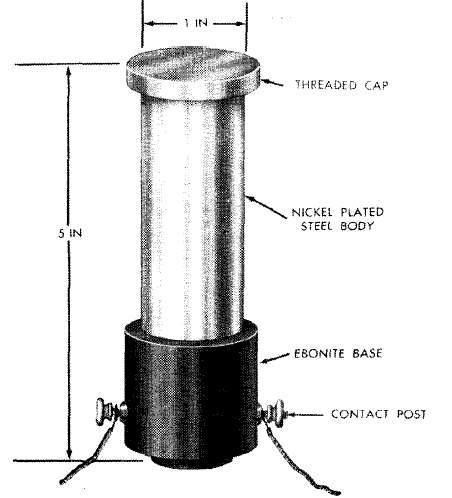
This fuze is a delay, chemical, handset type with a mercury contact. The EKhZ mercury delay fuze is about 1 inch in diameter and 5 inches in height. It consists of a cylindrical, nickel-plated steel body with a threaded cap, a hollow rubber cylinder, and an ebonite base. A chamber in the top of the fuze is for insertion of the mercury. Between the rubber cylinder and the mercury chamber is a fiber disk with a zinc wire closing a hole in the center of the disk. The base of the fuze is a hollow ebonite plug with two contact posts projecting out of the base, opposite each other. An electric wire lead is connected to each of these contact posts.
The fuze is used with improvised mines in areas being abandoned to an opposing force.
Functioning
The mercury erodes the zinc wire in the center of the disk in from 1 to 5 days. Mercury flows down into the ebonite contact chamber through the hole formed by erosion of the zinc wire. When the mercury rises high enough to touch both contacts, the circuit is completed.
Hazardous Components
No information about hazardous components.
Physical Data
No additional physical data available.
See Also
Nothing else to see.
Source(s)
